Investors: Market Cap Weighting Explained and a 4 Step Check
By MarketCapLens · Published · 7 min read

Market cap weighting assigns each company in an index a slice of influence proportional to its total market value, calculated as share price times shares outstanding. The direct consequence: giant companies move the index far more than small ones. This is why the S&P 500, NASDAQ 100, and Russell 2000 all lean on this method, and why a handful of trillion-dollar companies can drive most of a benchmark’s return in a given year.
TL;DR:
- Market cap weighting favors large companies, which often drive most of an index’s returns, especially in tech sectors with mega-cap stocks.
- Float-adjusted market capitalization excludes insider and insider-held shares, slightly reducing the influence of insiders on index weights.
- Self-adjusting and low-turnover, cap-weighted funds offer low costs and high liquidity, making them ideal for long-term investors seeking broad market exposure.
- Concentration risk exists as a handful of mega-caps can dominate index performance, reducing diversification and amplifying momentum bias.
- Alternatives like equal or smart beta weighting tilt towards small caps or value but usually entail higher turnover, costs, and differing risks.
Table of Contents
- What Market Cap Weighting Means and How the Math Works
- Why Index Providers Default to Cap Weighting
- The Practical Case for Cap-Weighted Funds
- The Downside: Concentration and Momentum Risk
- Equal-Weighted, Price-Weighted, and Smart Beta Compared
- How to Calculate and Verify Cap Weights Yourself
- What MarketCapLens Shows You About Index Concentration
- When Cap Weighting Makes Sense, and When It Doesn’t
- Check the Numbers Behind Any Index Yourself
- Sources
What Market Cap Weighting Means and How the Math Works
Market cap weighting rests on one formula. A company’s market capitalization equals its share price multiplied by shares outstanding (or, for many indices, only the publicly tradable “float-adjusted” shares). Its weight in the index is that market cap divided by the total market cap of every company in the index, a calculation Corporate Finance Institute lays out clearly.
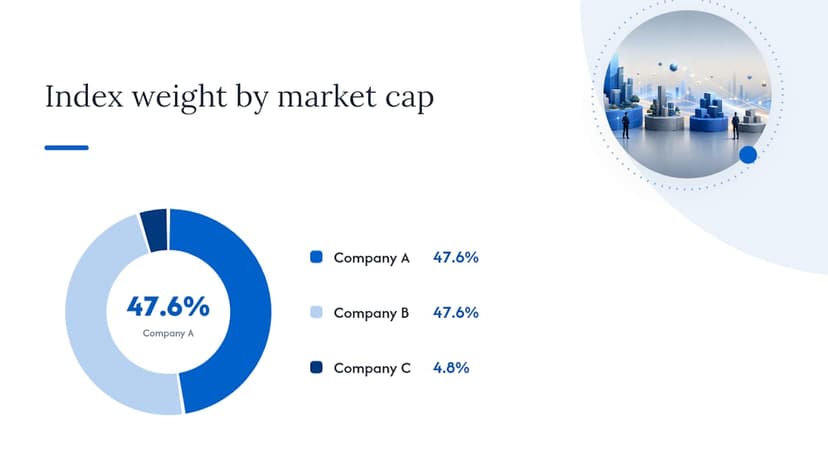
Here’s the arithmetic with three companies:
- Company A: $50 stock price × 2 billion shares = $100 billion market cap
- Company B: $200 stock price × 500 million shares = $100 billion market cap
- Company C: $10 stock price × 1 billion shares = $10 billion market cap
Total index market cap is the sum of the companies’ market caps. Company A’s weight is its market cap divided by the total, which is significantly larger than Company C’s, despite Company C having the lowest price. Price alone tells you nothing about weight; total market value tells you everything.
Pro Tip: The S&P 500 uses float-adjusted market cap, meaning shares held by insiders, governments, or other companies get excluded from the count. A founder holding 40% of a company’s stock doesn’t inflate that company’s index weight the way a fully public float would.
Why Index Providers Default to Cap Weighting
Cap weighting wins as the default because it manages itself. As a stock’s price rises or falls, its weight adjusts automatically. No committee needs to sell winners or buy losers to keep the index balanced.
That self-adjusting design is why Vanguard and academic researchers describe cap weighting as passive by nature, requiring far less intervention than schemes that need scheduled rebalancing.
The other draws:
- It mirrors how investors actually collectively own the market, dollar for dollar.
- Mega-cap stocks trade with deep liquidity, which keeps trading costs and tracking error low for funds replicating the index.
- Turnover stays lower than in most alternative weighting methods, since prices moving doesn’t force a trade.
The Practical Case for Cap-Weighted Funds
For most long-term investors, cap-weighted index funds remain the easiest, cheapest way to own the market. The logic is simple and the costs are low.
Cap weighting requires no judgment calls about which factor or fundamental metric deserves more weight. It just reflects market value.
- Fewer trades inside the fund mean lower expense ratios and less tax drag from realized gains.
- Weights track observable market caps, so anyone can verify holdings using public data.
- Deep liquidity in large-cap names keeps bid-ask spreads tight for fund managers.
Pro Tip: If you want a quick gut-check on whether a fund’s top holdings match a cap-weighted index, cross-reference its stated constituents against a live market cap ranking rather than trusting a fact sheet that might be a quarter old.
The Downside: Concentration and Momentum Risk
Cap weighting has a built-in feedback loop: as a stock’s price climbs, its index weight climbs too, pulling in more passive-fund buying that can push the price higher still. Corporate Finance Institute flags this as momentum bias, and it’s the same mechanism that let a small group of mega-cap technology stocks account for an outsized share of S&P 500 gains in recent years.
The main risks to weigh:
- A handful of mega-caps can dominate index returns, meaning you’re less diversified than the number “500” suggests.
- Small- and mid-cap stocks get diluted influence, so if that segment rallies, cap-weighted funds barely feel it.
- Performance rankings between weighting schemes shift by decade, with no single method winning every period.
None of this makes cap weighting flawed. It makes it exactly what it claims to be: a mirror of the market, warts included.
Equal-Weighted, Price-Weighted, and Smart Beta Compared
Three alternatives come up constantly once investors start questioning cap weighting.
Equal-weighted indices give every constituent the same slice regardless of size, which tilts exposure toward smaller companies and value stocks. Vanguard’s analysis shows this approach carries higher turnover and volatility than cap weighting, since constant rebalancing is required to keep weights equal. Price-weighted indices, the Dow Jones Industrial Average being the classic example, let a stock’s dollar price (not its company size) determine influence, an odd artifact of 19th-century index design that persists mostly out of tradition. Fundamentally weighted, or smart-beta, indices weight by metrics like earnings or book value instead of market price.
- Weighting rule: cap-weighted uses market value; equal-weighted uses a flat share; smart beta uses fundamentals.
- Turnover: cap-weighted is lowest; smart beta and equal-weighted rebalance more often, and FINRA notes this often means higher costs for investors.
- Exposure tilt: cap-weighted skews large-cap; equal-weighted and many smart-beta variants skew small-cap or value.
Smart beta can outperform in periods when value or small-cap factors are in favor, but that edge tends to come with a higher expense ratio attached.
How to Calculate and Verify Cap Weights Yourself
Checking a fund’s disclosed weights against reality takes four pieces of data: current share price, shares outstanding (or float-adjusted shares if the index uses float), the full constituent list, and the exact date and time the snapshot was taken.
- Pull the share price and float-adjusted share count for every constituent.
- Multiply price by shares to get each company’s market cap.
- Sum all constituent market caps to get the index total.
- Divide each company’s market cap by that total to get its weight.
| Input | Why it matters |
|---|---|
| Share price | Changes intraday; timing mismatches skew comparisons |
| Float-adjusted shares | Excludes locked-up or insider shares from the count |
| Constituent list | Must match the exact rebalancing date, since indices add and drop names |
| Corporate actions | Stock splits and M&A activity change shares outstanding overnight |
Rounding conventions and publish lags mean your hand-calculated weight might differ slightly from a provider’s official figure. For a live cross-check, MarketCapLens ranking pages update frequently enough to catch most same-day discrepancies.
What MarketCapLens Shows You About Index Concentration
Data resources track thousands of companies with frequent updates, giving you a live alternative to stale fund fact sheets when you want to check what’s actually driving an index.
The platform is built for exactly the kind of verification this article walks through:
- Real-time market caps for individual constituents, so you can spot-check a fund’s stated weights.
- Sector breakdowns that reveal concentration building up in specific industries, like AI-related stocks.
- Historical data showing how concentration has shifted over time, not just where it stands today.
Use it to confirm which companies actually anchor a “diversified” fund, or to track how quickly a sector’s share of the index is growing.
When Cap Weighting Makes Sense, and When It Doesn’t
Cap weighting is the right default for investors who want broad market exposure at the lowest possible cost and don’t want to think about rebalancing. It does what it says: it reflects the market as it actually is, not as anyone wishes it were.
Alternatives earn their place when you’re deliberately betting on a factor, like value or small-cap, and you’re willing to pay more in turnover and expenses for that tilt. Match the method to your goal and your tolerance for cost, not to whichever one had the best headline last year.
— MarketCapLens
Check the Numbers Behind Any Index Yourself
Reading about market cap weighting is one thing. Seeing which companies actually carry the weight in your fund is another, and that’s where a live data resource beats a static fact sheet every time. Specialized platforms provide real-time market cap rankings and sector breakdowns you won’t find in a quarterly report that’s already out of date by the time you read it.
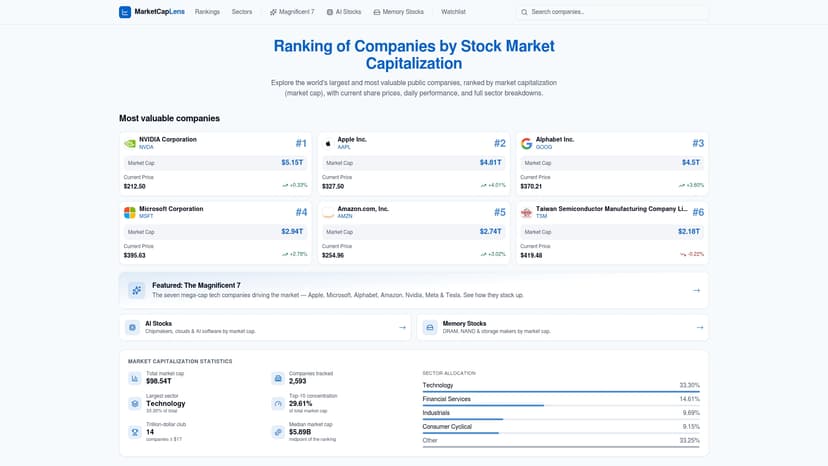
Start with the market cap rankings to see today’s largest constituents in any major index, or work through the plain-English market capitalization guide if you want the fundamentals reinforced before you dig into fund-level concentration on your own.
This article is general information, not a substitute for advice from a qualified financial advisor. Consult a qualified financial professional about your own circumstances before acting on anything here.
Sources
- Capitalization-Weighted Index - Overview, How To Calculate | Corporate Finance Institute
- Index weighting (academic paper) | Berkeley (PDF)
- Reevaluating market cap weighting | Investment Adviser Association
- Smart beta: What you need to know | FINRA
Recommended
For informational purposes only and is not investment advice. Do not rely on the facts, figures, ticker symbols, or other statements in this article — they may be incomplete, outdated, or incorrect, and we are not responsible for errors. See our disclaimer.