Follow-On Offering: How It Works and What It Does to a Stock
By MarketCapLens · Published · 11 min read
A follow-on offering (also called a follow-on public offering, or FPO) is a sale of securities to the public by a company that has already completed its IPO. Either the company sells new shares to raise cash, or existing shareholders sell shares they already own, or the deal mixes both. The distinction matters more than the label: new shares change the share count and therefore the market cap math, while resales by existing holders do not. On MarketCapLens, where market cap is price multiplied by shares outstanding, a follow-on is one of the few events that can move the second half of that formula overnight.
MarketcaplensTrack Market Cap After a Follow-OnCompare public companies with market cap, share price, sector, and historical data to put follow-on offering effects in context.VisitTL;DR
- A follow-on offering is any public share sale after the IPO. It is either primary (the company issues new shares and gets the money), secondary (existing holders sell and get the money), or a combination.
- Per Cornell’s Legal Information Institute, new-share offerings are dilutive, while resales of previously issued shares are not.
- “Secondary offering” here means the same thing as the secondary portion of a follow-on. It is not the stock market itself, which is also called the secondary market.
- The IPO is the first public sale of a company’s shares. Everything after it, registered with the SEC, is a subsequent or follow-on offering.
- To read one, check who gets the proceeds, how many new shares are created, and what happens to market cap at the new share count.
Table of Contents
- What a follow-on offering is
- Primary, secondary and combined offerings
- FPO vs IPO: what actually differs
- The rules that shape a follow-on
- What a follow-on does to share count and market cap
- How to read a follow-on announcement
- Follow-ons in the wider market picture
- Track the share count and market cap with MarketCapLens
- Our perspective
- FAQ
- Sources
What a follow-on offering is
An IPO is the first time a company offers its shares to the general public. The Congressional Research Service describes public offerings as consisting of IPOs and subsequent public offerings, and notes that the SEC requires offers and sales of securities to be either registered with it or covered by an exemption. A follow-on is a subsequent public offering: the company is already listed, its shares already trade, and it comes back to the market with more stock.
The reasons are usually practical. A company may want cash for acquisitions, debt repayment, research or capacity. Or early backers, founders and employees who hold shares from private financing rounds want to sell part of their stake. The Public Company Handbook (7th edition, July 2026) notes that secondary offerings give liquidity to holders such as those with restricted shares from private financings.
The securities do not have to be shares. Practical Law notes that after an IPO an issuer may offer additional debt or equity to the public. This article stays with equity, which is what changes market cap.
Primary, secondary and combined offerings
Three structures cover almost every follow-on you will read about.
| Structure | Who sells | Who gets the money | Share count | Dilutive? |
|---|---|---|---|---|
| Primary | The company, issuing new shares | The company | Rises | Yes |
| Secondary | Existing shareholders | The selling shareholders | Unchanged | No |
| Combined | Both, in one prospectus | Split between the two | Rises by the primary part | Partly |
The table follows the description in Cornell’s Wex entry and the Lexology equity capital markets chapter, which says that in a secondary offering the holder rather than the company receives the proceeds and that no new shares are issued. The same chapter explains that the company and the selling holder typically agree beforehand, through a registration rights agreement, on the company’s help with filing and keeping a registration statement effective.
Practical Law adds that a follow-on can consist of both types, for example when an issuer registers additional common shares while certain shareholders sell in the same offering. The Public Company Handbook makes the same point about registered offerings that combine primary and secondary portions.
Why “secondary offering vs follow-on” confuses people
The terms overlap rather than compete. A follow-on is the broad category: any public offering after the IPO. A secondary offering is one kind of follow-on, the kind where holders sell. If a headline says “secondary offering,” ask one question: is any of it new stock? If yes, it is partly primary and dilutive. If no, the company’s share count does not change.
FPO vs IPO: what actually differs
Both are registered public offerings, and both give investors a prospectus with disclosures. The differences are in what the market already knows.
- Price discovery. An IPO has no trading price to anchor to, so the offer price is set by the underwriters and the company. A follow-on is priced against a live market price, usually at a discount to the last close. We explain how a first close can reset a newly listed company’s value in our piece on IPO pricing and market cap.
- Information. A company doing a follow-on has an SEC reporting history. According to the Mayer Brown regulatory overview (May 2026), eligible issuers with at least 12 months of public-company reporting may use Form S-3 for later offerings and refer in the prospectus to their existing SEC reports.
- Speed. Because of that incorporation by reference, a follow-on can often be done faster than an IPO, which is why established companies can raise money opportunistically.
- Seller. An IPO is mostly about the company raising capital and creating a public market. A follow-on is frequently about holders selling down.
The rules that shape a follow-on
Under the SEC’s form rules in 17 CFR Part 239, a company may use Form S-3 for primary or secondary cash offerings if it meets the registrant requirements. These include 12 months of required filings made on time and no unpaid preferred dividends or material defaults on debt or long-term leases. For these offerings, the market value of voting and nonvoting common equity held by non-affiliates must be at least $75 million, measured within 60 days before filing.
Two practical consequences follow for anyone screening companies:
- Small and recently listed companies often use a longer form. Without S-3 eligibility, a company files a fuller registration statement. A Harvard Law School Forum post (July 19, 2026) describes an SEC proposal that would let a newly public company doing a follow-on on Form S-1 incorporate its earlier filings, including its IPO registration statement. It is a proposal, so check the SEC’s site for its status.
- Shelf registration lets companies move quickly. The same post notes that many newly public companies are likely to file an S-3 shelf soon after the IPO as a vehicle for future raises.
Shelf offerings and at-the-market programs
A shelf registration registers securities in advance so the company can sell them later, when conditions suit. The Cornell entry notes that follow-ons are often structured this way.
An at-the-market (ATM) program is a shelf variant. According to Cleary Gottlieb (November 2020), the issuer sells into the existing market over time at prevailing prices, through broker-dealer agents, under an effective shelf registration. The memo says issuers must generally be S-3 eligible on a primary basis, with at least $75 million of public float and 12 months of reporting, though most ATM issuers have at least $150 million of float. Lexology adds that the filing specifies the total dollar amount to be sold and the intended use of proceeds.
For a reader tracking prices, the difference is visible. A traditional underwritten follow-on is a one-day event with a clear announcement. An ATM program is a slow drip: shares outstanding creep up quarter by quarter, and the news is a line in a filing.
What a follow-on does to share count and market cap
Market cap is share price times shares outstanding. A primary follow-on raises the second number. Whether market cap rises or falls then depends on what the price does.
A worked example
The figures below are illustrative, not a real company.
A company has 100 million shares at $50, so a market cap of $5.0 billion. It sells 10 million new shares at $48 each, raising $480 million before fees.
- Shares outstanding: 110 million.
- If the price stayed at $50, market cap would be $5.5 billion.
- If the price settles at $48, market cap is $5.28 billion.
- An existing holder with 1 million shares owned 1.00% before and owns about 0.91% after.
Market cap can rise even as the share price falls, because the company now holds the cash it raised. What matters to a long-term holder is whether the company can earn more on that cash than the dilution costs them. Our guide to share dilution effects walks through what happens to a stake and to returns, and our explainer on what makes market cap go up or down covers the price-versus-shares logic in general.
If the same 10 million shares came from selling holders instead (a pure secondary), shares outstanding stay at 100 million, the company gets no money, and ownership percentages of everyone else do not change.
Why the price often dips
The Lexology chapter notes that a primary offering is dilutive to existing shareholders from a voting perspective. Beyond voting, pricing below the last close and added supply both tend to weigh on the stock around announcement. Cleary Gottlieb observes that ATM programs affect stock prices less than traditional follow-ons because shares are sold in small batches, with lower agent commissions than underwriting discounts. It also warns that the creation of a program can create overhang that depresses the price, and that raising large sums quickly at a fixed price is impractical in that format.
These are patterns, not rules. A follow-on that funds a well-regarded acquisition can be received well, and the Congressional Research Service points to a possible “liquidity premium” for public companies, meaning better share pricing than comparable private offerings.
How to read a follow-on announcement
When a company you follow announces a follow-on, work through this list.
- Primary, secondary or both? The prospectus summary states how many shares the company sells and how many selling shareholders sell.
- Who is selling? A founder or a venture investor reducing a stake is different from a company funding growth. Both are legitimate, but they tell different stories.
- Use of proceeds. Debt repayment, acquisitions and capital spending have different implications for earnings per share.
- Size relative to the float. Ten million shares matters a lot more against 50 million shares outstanding than against 2 billion.
- Pricing. Compare the offer price with the last close, then recompute market cap at the new share count.
- Program type. A one-time underwritten deal and an ATM program have different timing and price effects, as above.
The arithmetic in steps 4 and 5 is quick with the Market Cap Calculator, which multiplies price by shares. If you want to test whether new capital justifies the dilution, the Enterprise Value Calculator and DCF Calculator let you put cash, debt and value per share side by side.
Follow-ons in the wider market picture
One company’s offering is a data point; many together are a signal. Clusters of follow-ons in a sector can mean companies are using strong prices to raise cash. Our sector rankings show how companies in each sector stack up by market cap, and our note on spotting narrow rallies in daily performance shows how to tell whether a move is broad or concentrated.
Follow-ons also interact with other share-count events. A buyback shrinks the count and a follow-on enlarges it; see our three checks for buybacks and market cap. A stock split changes the count and price without touching value, as covered in why splits leave market cap unchanged. Companies with several share classes need the classes combined, which we explain in dual-class shares and market cap.
Track the share count and market cap with MarketCapLens
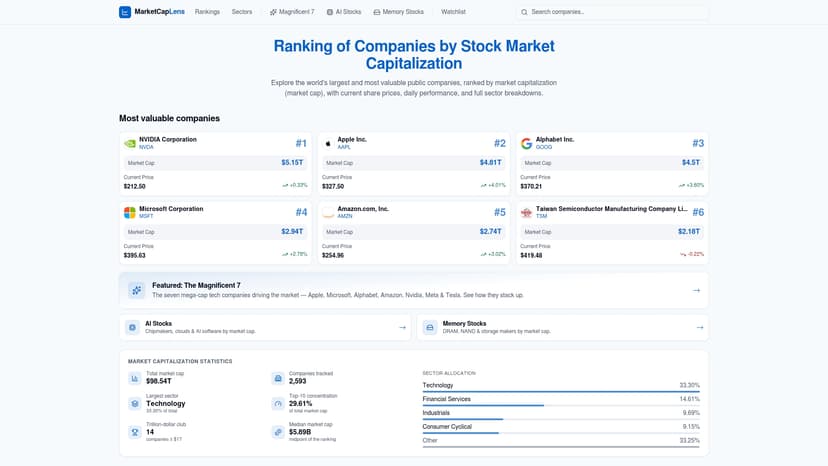
A follow-on only makes sense when you see the market cap before and after it. MarketCapLens tracks over 2,500 public companies, with prices and rankings updated multiple times daily, so you can see how a company’s size and position move around an offering. Start from the market cap rankings and use the tools to rerun the numbers at the new share count.
Our perspective
Most explanations of follow-on offerings stop at the definition. We think the useful question is what the offering does to the size of the company on the screen.
Market cap is the product of two numbers, and a follow-on touches the one that investors tend to watch least. Price gets the headlines; share count quietly decides how big a company really is and how much of it each share represents. That is why we rank companies by market cap, break them down by sector, and refresh the figures multiple times a day: a change in either input should show up in the ranking.
Our aim is to explain these events in plain English next to the live data, so a student, an analyst or an individual investor can go from the question “who is selling, and how many new shares?” to a recomputed market cap in a minute.
MarketCapLens
FAQ
What is a follow-on offering?
It is a public sale of securities by a company that has already had its IPO. The company may sell new shares, existing shareholders may sell theirs, or both can happen in one offering. The sale must be registered with the SEC or fit an exemption.
Is a secondary offering the same as a follow-on offering?
Not exactly. A follow-on is the broad category of public offerings after the IPO, and a secondary offering is the kind where existing holders sell and receive the proceeds. A secondary creates no new shares, so it is not dilutive. A follow-on that includes new shares is partly primary.
What is the difference between an FPO and an IPO?
An IPO is the first time a company offers its shares to the general public. An FPO comes later, when the stock already trades, so it is priced against a market price and can lean on the company’s existing SEC reports. Both are registered offerings with a prospectus.
Does a follow-on offering always lower the stock price?
No. Offerings are often priced at a discount and add supply, so dips around announcement are common, but the outcome depends on how the market views the use of proceeds. The share price can fall while market cap holds up, because the company receives cash for the new shares.
How can I tell if a follow-on is dilutive?
Check whether the company is issuing new shares. If shares outstanding rise, it is dilutive. If only existing holders sell, the count stays the same. The prospectus states the split between company and selling-holder shares.
Sources
- Follow-on offering, Legal Information Institute (Cornell)
- Capital Markets: Public and Private Securities Offerings, Congressional Research Service
- Equity Capital Markets in the USA, Lexology
- The Public Company Handbook, Seventh Edition
- Follow-On Offering, Practical Law
- 17 CFR Part 239 Subpart A, eCFR
- The SEC’s Registered Offering Reform Proposal, Harvard Law School Forum
- Alternative Capital Raising for Public Companies, Cleary Gottlieb
- At-the-Market (ATM) Offerings Rise in Popularity, Lexology
- Capital Markets in the United States: Regulatory Overview, Mayer Brown
Recommended
For informational purposes only and is not investment advice. Do not rely on the facts, figures, ticker symbols, or other statements in this article — they may be incomplete, outdated, or incorrect, and we are not responsible for errors. See our disclaimer.