Index Fund vs ETF: Differences, Taxes and How to Choose
By MarketCapLens · Published · 12 min read
An index fund and an ETF are not opposites. An index fund is a strategy: it tracks a market index. An ETF is a fund structure that trades on an exchange, and it can hold an index strategy or an active one. So the real choice is usually between an index mutual fund and an index ETF. They hold nearly the same stocks, but they differ in how you buy them, how they are priced, what minimums apply and how they are taxed.
MarketcaplensSee the Companies Behind the MarketCompare market leaders with real-time share prices, historical data, and sector breakdowns across more than 2,500 public companies.Explore market dataTL;DR
- “Index fund” describes what a fund does (tracks an index). “ETF” describes how it is packaged and traded. Many ETFs are index funds, and so are many mutual funds.
- Index mutual funds trade once a day at net asset value (NAV). ETFs trade all day at market prices, like stocks.
- In a taxable account, ETFs have historically distributed fewer capital gains. In an IRA or 401(k), that edge mostly disappears.
- Your account often decides for you: 401(k) menus are mostly mutual funds, while many robo-advisers and brokerage accounts lean on ETFs.
- If two funds track the same index, compare expense ratio, trading costs and tracking, not the label.
Table of Contents
- What is the difference between an index fund and an ETF?
- How you buy and sell each one
- Costs: expense ratios, minimums and trading fees
- Taxes: where ETFs have had the edge
- Which one fits you?
- Are ETFs safer or likelier to beat index mutual funds?
- Perspective
- See what your fund actually owns
- A simple decision checklist
- FAQ
- Sources
What is the difference between an index fund and an ETF?
The SEC’s investor education site defines an index fund as a type of mutual fund or ETF that seeks to track the returns of a market index, such as the S&P 500, the Russell 2000 or the Wilshire 5000. You cannot invest in an index directly, so an index fund is the indirect route.
The SEC’s April 2025 bulletin explains that both mutual funds and ETFs pool money from many investors. Each share represents proportionate ownership of the fund, and either structure can follow a passive (index) or an active strategy. A passive strategy aims to deliver roughly the return of a particular index.
That gives you a simple map:
| Index mutual fund | Index ETF | Active ETF or mutual fund | |
|---|---|---|---|
| Strategy | Tracks an index | Tracks an index | Manager picks securities |
| Structure | Mutual fund | Exchange-traded | Either |
| Typical use | 401(k) menus, automatic investing | Brokerage accounts, robo-advisers | Seeking to beat an index |
So when someone searches “ETF vs index fund,” the clean comparison is index mutual fund versus index ETF. Comparing “ETF” with “index fund” as if they were separate categories mixes a structure with a strategy. Keep that straight and most of the confusion disappears.
How you buy and sell each one
This is the most visible difference in daily use.
Index mutual funds are priced once a day. The New York Fed explains that mutual fund shares are priced at the end of the trading day based on net asset value, so everyone who trades that fund on a given day gets the same price. Place an order at 10 a.m. or 3 p.m. and it fills at the same number.
ETFs trade on national stock exchanges at market prices, which, per the same New York Fed article, often differ slightly from NAV during the day. You can buy or sell any time the market is open. Morningstar notes that ETF investors can also use order types such as limit, stop-loss and stop-limit orders, which a once-a-day mutual fund cannot offer.
Two practical consequences:
- Intraday control. If you want to set a price limit or act during market hours, an ETF gives you that. S&P Dow Jones Indices points out that because ETFs trade like stocks, they can be bought on margin or sold short, which is harder to do with mutual funds.
- Where you can hold them. The SEC notes that retail investors can only buy and sell ETF shares in market transactions on an exchange. That means a brokerage account. Mutual funds can often be bought straight from the fund company.
Why an ETF’s price stays close to its value
If ETFs trade like stocks, why don’t they drift far from the value of their holdings? Large broker-dealers called authorized participants create and redeem ETF shares in big blocks. When the market price moves away from NAV, they can trade to pull it back. The SEC’s ETF bulletin describes this arbitrage mechanism as what keeps the market price generally close to the end-of-day NAV. For a broad, heavily traded index ETF, the gap is usually tiny. You still see it as a bid-ask spread when you trade.
Costs: expense ratios, minimums and trading fees
Both structures charge an annual expense ratio, a percentage of fund assets. California’s 2025 investor guide notes that this can range from 0.05% to 2.5%, and that index funds making similar investments tend to sit near 0.07%, versus an average of 0.52% for actively managed equity funds.
The SEC adds a useful caution: because index funds do not pay for stock-picking research, they may be able to save costs, but not every index fund is cheaper than every active fund. Check the actual cost of the specific fund.
For the same index, the expense ratio gap between an ETF and a mutual fund is often a few hundredths of a percentage point, and it can run either way. Compare the two funds you are actually considering, because the wrapper alone does not tell you which is cheaper.
Other costs to weigh
- Minimums. Some mutual funds set a minimum initial investment, often in the thousands of dollars. An ETF can be bought for the price of one share, and many brokerages now allow fractional shares. Check the fund’s prospectus and your brokerage for current terms.
- Commissions. The SEC’s investor guide says ETF investors typically pay brokerage commissions on each purchase or sale, though some ETFs are available commission-free. With a flat fee, the smaller the trade, the bigger the percentage cost. Many large brokerages now charge no commission on online ETF trades, so confirm what yours charges.
- Bid-ask spreads and market impact. Morningstar cautions that ETF investors may face bid-ask spreads and market-impact costs, which matter more for large trades in thinly traded ETFs. For a broad, popular fund and a modest order, this cost is typically small.
A worked example makes the trade-off concrete. Say you invest $200 every month. With a mutual fund, each deposit buys shares at the day’s NAV with no spread. With an ETF, each purchase is a market trade, so a flat commission would eat a visible percentage of $200 if your broker charges one. If your broker charges nothing and offers fractional shares, the difference is negligible. If you invest one large sum once, the reverse applies: a spread on a liquid ETF is a rounding error.
Taxes: where ETFs have had the edge
Taxes are the reason many investors favor ETFs, and also the area where the answer depends most on the account.
In a taxable brokerage account
The law requires mutual funds and ETFs to distribute net capital gains from selling portfolio securities. The SEC’s guide warns you may owe tax each year on those distributions, even if the fund lost money and you never sold a share.
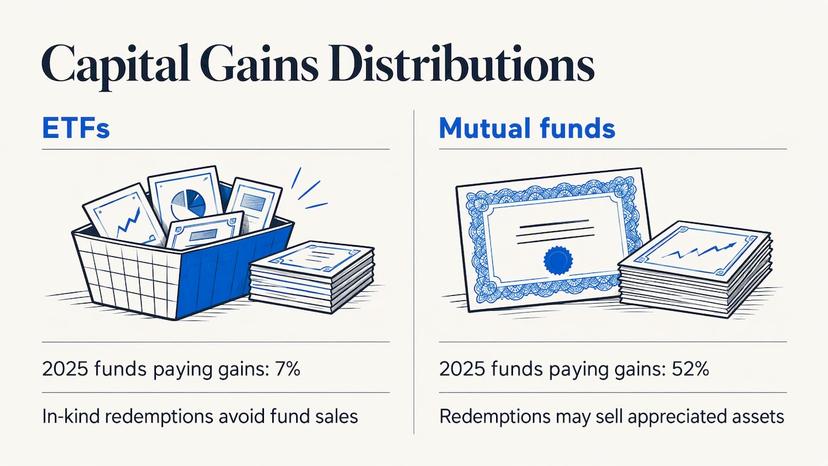
The same guide notes that taxes on ETF investments have historically been lower than on mutual funds because certain ETFs redeem in kind. Morningstar’s Amy Arnott explains the mechanism: when large institutions sell, the ETF can hand over actual securities instead of selling them, which avoids realizing capital gains inside the fund. A mutual fund facing heavy redemptions may have to sell appreciated holdings, and the gains are passed to all remaining shareholders.
The gap shows up in the numbers. One 2026 analysis reports that in 2025 only 7% of ETFs paid capital gains compared with 52% of mutual funds. Kiplinger’s rule of thumb follows from this: use ETFs in taxable accounts because they are less likely to distribute gains.
A caveat on the caveat: broad index mutual funds are already low-turnover and often distribute little. Morningstar says the choice is not automatic and depends on what you value, including where and how you invest and how much you hold. Look at a specific fund’s recent capital gains distribution history, which fund companies publish.
A note on dividends: both structures pass dividends through, and those are taxed in a taxable account either way. The in-kind advantage affects capital gains distributions, not dividend income.
In an IRA or 401(k)
Inside a tax-advantaged account, the tax-efficiency argument largely goes away. The SEC guide says the ETF tax advantage is not relevant in a tax-advantaged account such as an IRA or 401(k). Kiplinger makes the practical point that in retirement accounts the choice comes down to annual cost and fees, not annual tax efficiency.
If you hold less tax-efficient funds, Morningstar suggests keeping them in the tax-advantaged account. Its example is real estate investment trusts, whose dividends are generally taxed at ordinary income rates. For taxes beyond this, such as your own bracket, state rules or a large sale of appreciated shares, a CPA or enrolled agent can run your numbers.
Which one fits you?
Start with the account, then the habits, then the fine print.
Choose by account type
- Workplace 401(k): AAII notes that these plans are generally limited to mutual funds (or a similar pooled vehicle), while robo-advisers often use ETFs. Your menu may make the decision for you. Pick the lowest-cost broad index option offered.
- Taxable brokerage account: ETFs are often the natural fit because of the distribution record above.
- IRA: Either works. Compare expense ratio and how easily you can automate contributions.
Choose by habit
- You invest automatically every month in exact dollar amounts. A mutual fund handles this simply. Many brokerages now offer automatic ETF purchases with fractional shares too, so check yours.
- You want to trade during the day or use limit orders. AAII’s Rotblut says that if intraday trading matters, ETFs may be preferable.
- You want to buy once and hold for decades. Either structure suits you. Focus on cost and the index.
Choose by index, not by label
AAII suggests beginners start with broad-based funds that tend to have low expense ratios, diversification and tax efficiency, and to compare the index a fund follows. Two funds with different labels can hold very different things. A U.S. total market fund, an S&P 500 fund and a global fund behave differently. Our comparison of VT and VTI shows how much that choice matters, and our explainer on market cap weighting shows how most of these indexes decide how much of each company you own.
Are ETFs safer or likelier to beat index mutual funds?
Neither. If both funds track the same index, they aim to deliver that index’s return. S&P Dow Jones Indices says that if the index loses value, the fund’s return reflects that loss too. The structure does not shield you from market declines.
The SEC lists the real differences between index funds of any kind: lack of flexibility, tracking error (the fund may not match its index perfectly) and underperformance from fees, expenses and trading costs. Any gap between two same-index funds comes from those items. So a lower-cost ETF can edge out a pricier mutual fund, and a lower-cost mutual fund can edge out an ETF. Compare the numbers fund by fund.
It is also worth knowing how concentrated popular indexes have become, since an index fund owns whatever the index owns. Our look at S&P 500 concentration tracks how much the largest companies now weigh.
Perspective
We look at funds from the inside out: through the companies they hold. Whether you own an index through a mutual fund or an ETF, you end up owning the same large companies in proportion to their market capitalization. That is why we think the wrapper matters less than most headlines suggest, and the index matters more.
Before choosing a fund, we suggest checking what it owns. See which companies sit at the top of the market cap rankings, how much of the index a handful of names represent, and which sectors dominate. Our tracker covers more than 2,500 companies, with data refreshed several times a day, so you can see the weights behind any index fund.
Once you know the index, the wrapper decision gets simple: match it to your account, your tax situation and how you invest. And if you want to build a portfolio by sector, our sector allocation starter plans show how ETFs can express that idea in three to five holdings.
MarketCapLens
See what your fund actually owns
Once you have picked an index fund or ETF, the next question is what is inside it. At MarketCapLens, you can see the world’s largest public companies ranked by market cap, with share prices, sector breakdowns and daily and historical performance for more than 2,500 companies.
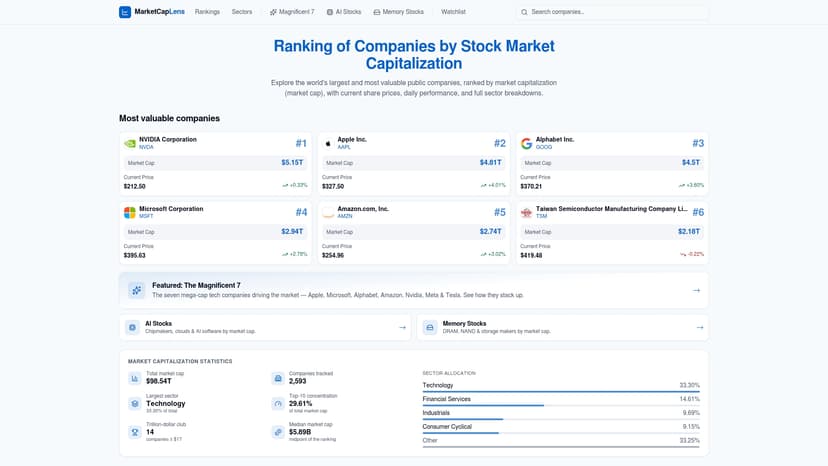
Start with the market cap rankings to see the biggest names that dominate most broad indexes, or browse companies by sector to understand how a fund’s weights break down. Our stock calculators help you size positions and returns.
A simple decision checklist
- Identify the index. Confirm both funds track the same one.
- Note your account. 401(k): likely mutual fund. Taxable: ETF often fits. IRA: either.
- Compare expense ratios. Use the fund’s current prospectus figure.
- Check your brokerage’s terms. Look at commissions, fractional shares and automatic investing.
- Check minimums. Mutual funds may set an initial minimum, while ETFs can cost one share or less.
- Look at distribution history in a taxable account. Fund companies publish past capital gains payouts.
- Decide how you will trade. If you only buy and hold, trading flexibility is a minor factor.
Morningstar frames the decision as feature-driven: choose the vehicle that best matches what you value, including trading flexibility, taxes, ease of reinvesting and where you invest. That is a sound way to settle it.
FAQ
Is an ETF an index fund?
Often, but not always. An ETF is a structure, and it can follow an index or be actively managed. Fidelity’s analysis of Bloomberg data found that a little over 40% of ETFs are passively managed. Check the fund’s stated objective to see whether it tracks an index.
Are ETFs good for beginners?
They can be, if you choose a broad, low-cost index ETF. AAII recommends beginners start with broad-based funds with low expense ratios and diversification. An index mutual fund with the same index is equally suitable, especially inside a 401(k).
Do index funds or ETFs cost less?
It depends on the specific funds. Index funds in general tend to cost less than active funds, per the California Investor Guide. Between an index ETF and an index mutual fund tracking the same benchmark, compare expense ratios and your brokerage’s trading costs directly.
Which is better for taxes, an index fund or an ETF?
In a taxable account, ETFs have historically distributed fewer capital gains because of in-kind redemptions, per the SEC’s investor guide. In an IRA or 401(k), that advantage is not relevant. Ask a tax professional about your own situation.
Sources
- Index Funds, Investor.gov (SEC)
- Characteristics of Mutual Funds and Exchange-Traded Funds, Investor.gov (SEC)
- Investor Bulletin: Exchange-Traded Funds, Investor.gov (SEC)
- Mutual Funds and ETFs: A Guide for Investors, Investor.gov (SEC)
- NBFIs in Focus: The Basics of Mutual Funds and ETFs, New York Fed
- California Investor Guide 2025
- Traditional Index Fund vs. ETF Cage Match, Morningstar
- Ask the Analyst: What Investors Need to Know About Taxes, Morningstar
- How to Choose Between Look-Alike ETFs and Mutual Funds, Kiplinger
- Choosing the Right Mutual Fund or ETF for You, AAII
- Index Access Via Products, S&P Dow Jones Indices
- ETF vs Mutual Fund: Key Differences That Matter, Western & Southern
- ETF vs. index fund: What’s the difference? Fidelity
Recommended
For informational purposes only and is not investment advice. Do not rely on the facts, figures, ticker symbols, or other statements in this article — they may be incomplete, outdated, or incorrect, and we are not responsible for errors. See our disclaimer.