Largest Saudi Companies by Market Cap in 2026
By MarketCapLens · Published · 10 min read
The largest Saudi company by market capitalization is Saudi Aramco, and the gap to everything else on the Saudi Exchange (Tadawul) is wide. On 17 November 2026, Saudi Exchange’s Daily Financial Indicators report listed Aramco (ticker 2222) at SAR 26.38 per share with a market cap of SAR 6,383,960 million, or about SAR 6.38 trillion. Behind it sit the big banks, a mining group, and utility, telecom and chemicals names. This guide shows who they are, how the figures are built, and how to compare them with U.S. companies without making a currency or date mistake.
Marketcaplensmarketcaplens.comCompare Saudi Companies by Market CapMarketCapLens tracks thousands of public companies with frequently updated share prices, historic data, and sector breakdowns for market comparisons.VisitTL;DR
- Saudi Aramco (2222) leads Tadawul by a wide margin: SAR 6,383,960 million in market cap on 17 November 2026, at SAR 26.38 per share.
- Ma’aden (1211) was listed at SAR 225,548.25 million that day, at SAR 58.00 per share, so it is a fraction of Aramco’s size.
- Al Rajhi Bank (1120) and Saudi National Bank (1180) are the largest banking names, and both trade on the same exchange.
- Rankings move daily with share prices. Always compare two companies on the same date and in the same currency.
- Aramco is mostly owned by the Saudi government, so its free float (shares available to trade) is much smaller than its headline market cap.
Table of Contents
- How market cap is calculated, and why the date matters
- The largest Saudi companies, one by one
- Why Aramco’s size needs context
- Comparing Aramco with Apple the right way
- How to build your own Saudi watchlist
- What Saudi Arabia’s biggest companies say about the economy
- Where to find our U.S. coverage
- FAQ
- Sources
How market cap is calculated, and why the date matters
Market capitalization is the share price multiplied by the number of shares outstanding. It tells you what the stock market values the whole company at, not what the company earns or owns. You can run the arithmetic yourself with our market cap calculator, which takes price and share count and returns the total.
Three details decide whether a Saudi ranking is useful or misleading.
Currency. Tadawul quotes prices and market values in Saudi riyals (SAR). The exchange’s daily report gives market caps in SAR millions. Many rankings online convert to U.S. dollars. A converted figure depends on the exchange rate the publisher used, so two lists can differ for that reason alone.
Date. Share prices change every trading day. The figures in this article are the published values for 17 November 2026. Read them as a snapshot of that day, and check the live exchange report or a live ranking before you rely on them.
Scope. Tadawul’s main market and its smaller parallel market are different lists. The report we cite covers the Main Market, which is where the large companies trade.
One more caution for U.S. readers: a company’s market cap and its revenue produce different rankings. A list sorted by sales will put some names first that a list sorted by market value will not. This article ranks by market cap because that is what investors compare when sizing up listed companies.
The largest Saudi companies, one by one
The table below uses the figures the Saudi Exchange reported for 17 November 2026 where we have them, and the companies’ own descriptions for the rest. Market caps for Al Rajhi Bank and Saudi National Bank are not shown because we did not take a dated exchange figure for them; look them up in the live report.
| Company | Ticker | Sector | Market cap, 17 Nov 2026 |
|---|---|---|---|
| Saudi Aramco | 2222 | Energy | SAR 6,383,960 million |
| Ma’aden | 1211 | Mining and metals | SAR 225,548.25 million |
| Al Rajhi Bank | 1120 | Banking | See live exchange report |
| Saudi National Bank | 1180 | Banking | See live exchange report |
The exchange report is the primary record for these numbers. Open it and sort by market cap to see the full top of the list, including telecom, utility and chemicals names.
Saudi Aramco (2222)
Aramco is in a category of its own. By its own account, the company traces its origins to 1933, operates in more than 50 countries and employed 76,664 people as of 31 December 2025. Aramco’s at-a-glance page reports adjusted net income of ﷼392.5 billion ($104.7 billion), free cash flow of ﷼320.4 billion ($85.4 billion) and total hydrocarbon production of 12.9 million barrels of oil equivalent per day for the 2025-2026 financial year.
Those earnings explain why the market values it so highly. The company also published its third-quarter 2026 results on 3 November 2026, and quarterly results like these are among the events that move the share price.
For sector context, see how oil and gas names rank in the U.S. on our largest energy companies by market cap page.
Al Rajhi Bank (1120)
Headquartered in Riyadh, Al Rajhi Bank describes itself in its 2025 investor report as the world’s largest Islamic bank. It reports SAR 1,043 billion (USD 278 billion) in assets, paid-up capital of SAR 40 billion (USD 11 billion) and more than 25,000 employees. It trades on Tadawul under the ticker 1120.
Islamic banking means financing and deposit products structured to follow Shariah principles, for example without charging conventional interest. For an analyst, that changes how you read a bank’s income lines, but the market cap works exactly as it does for any listed bank.
Saudi National Bank (1180)
Saudi National Bank (SNB) was formed by merging NCB and Samba. Its About Us page calls it the largest banking group in Saudi Arabia, with paid-up capital of SAR 60 billion. It offers Islamic banking, business services through its ITQAN unit and investment services through SNB Capital, and holds a 67.03% shareholding in Türkiye Finans.
If you track banks across markets, compare these two with U.S. peers on our largest financial services companies by market cap page.
Ma’aden (1211)
Ma’aden is the Saudi mining and metals group. On 17 November 2026 the Saudi Exchange listed it at SAR 58.00 per share and a market cap of SAR 225,548.25 million. That makes it one of the large non-oil names on the exchange, and a useful marker of how far Saudi Arabia’s listed economy reaches beyond crude oil.
Why Aramco’s size needs context
Aramco’s headline number overstates how much of the company the public can buy. Aramco’s investor FAQ states that the Government of the Kingdom of Saudi Arabia owns more than 81.48% of its shares, and that total foreign ownership is capped at 49% under Capital Market Authority and exchange rules.
The history explains the structure. Aramco’s own timeline says the Saudi government bought a 25% interest in 1973, raised it to 60% in 1974 and to 100% in 1980, with Saudi Arabian Oil Company officially established eight years later. The U.S. Department of State’s 2019 Investment Climate Statement described Aramco as 100 percent state-owned at that time, with five of eleven board representatives from the Saudi government, including the chairman and vice chairman.
So the short answer to a common question: Aramco was fully state-owned, and today the government remains the dominant shareholder, with the rest held by public investors.
Why this matters for analysis:
- Market cap is not float. Market cap counts every share. Float counts only shares available for trading. Index providers often weight by float, so Aramco’s weight in an index can look smaller than its headline value.
- Concentration affects sector shares. When one energy company is this large, the energy sector’s share of Tadawul is dominated by a single stock.
- Foreign ownership limits are rules, not opinions. A 49% cap is written into the market’s rules, so check how it applies before assuming you can hold a given share in a given account.
Comparing Aramco with Apple the right way
Readers often ask whether Aramco is bigger than Apple. Both rank among the most valuable listed companies in the world, and the answer can change from one week to the next. A fair comparison needs three steps.
- Pick one date. Take both closing prices from the same trading day. Tadawul and U.S. exchanges close at different hours and have different holidays, so use the last day both traded.
- Pick one currency. Aramco’s market cap is quoted in SAR. Convert it into U.S. dollars with one exchange rate from a central bank source, and say which rate you used.
- Use the same share count basis. Use total shares outstanding for both, rather than float for one and total for the other.
Then compare the two results. We can take you through the calculation with our market cap calculator: enter price and shares for each company and you have a like-for-like figure. We do not state a current Aramco-versus-Apple verdict here, because it depends on the date and exchange rate you choose.
How to build your own Saudi watchlist
A ranking is a starting point. A watchlist turns it into research. Here is a routine that works for students and professionals alike.
- Start from the exchange’s own report. The daily indicators page lists closing prices and market caps for each listed company, in SAR millions. It is the primary record.
- Group by sector. Put Aramco in energy, Ma’aden in materials, Al Rajhi Bank and SNB in financials. Sector grouping shows what the Saudi market is made of and how concentrated it is.
- Set the U.S. peer next to each name. For energy, look at the U.S. majors. For banks, the largest U.S. lenders. This is where our sector rankings help, because each sector page ranks companies by market cap in one view.
- Check the fundamentals behind the size. Market cap says what the market pays. Enterprise value adds debt and subtracts cash, which matters for capital-heavy businesses. Our enterprise value calculator does that step, and the DCF calculator estimates intrinsic value per share from your own cash flow assumptions.
- Record the date next to every number. A market cap without a date is not a data point.
Investors who think about spreading exposure beyond one market or one asset class may also want to read about property portfolio expansion strategies, which cover diversification from a real estate angle.
What Saudi Arabia’s biggest companies say about the economy
Two patterns stand out in the list.
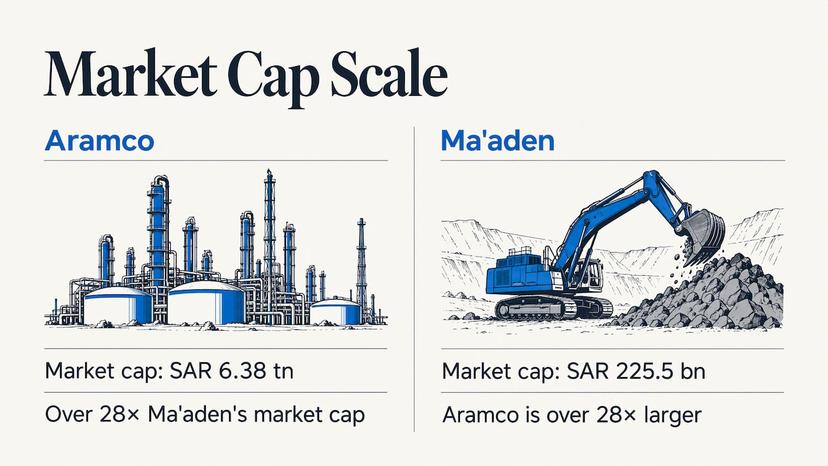
First, energy dominates by size. Aramco’s SAR 6.38 trillion market cap on 17 November 2026 is more than 28 times Ma’aden’s SAR 225.5 billion, and Ma’aden is itself a very large company.
Second, banks are the other pillar. SNB says it was formed to support the Kingdom’s Vision 2030 programme, the national plan to broaden the economy, and Al Rajhi Bank’s investor report describes a move from a bank toward an ecosystem of broader financial services. Both are the companies’ own descriptions, and both show how the financial sector is positioning itself for growth outside oil.
For an analyst, the takeaway is to watch relative moves between sectors, not only the top line. A rising Ma’aden or bank weighting against Aramco is a sign of diversification in the listed market.
Where to find our U.S. coverage
We built MarketCapLens to rank the world’s largest public companies by market capitalization, with real-time share prices that refresh multiple times a day, sector breakdowns and historical performance for more than 2,500 companies. If you are benchmarking Saudi names against U.S. ones, start with the market cap rankings, then open a sector page to see how each industry stacks up. The tools page collects the calculators for size, value and returns.
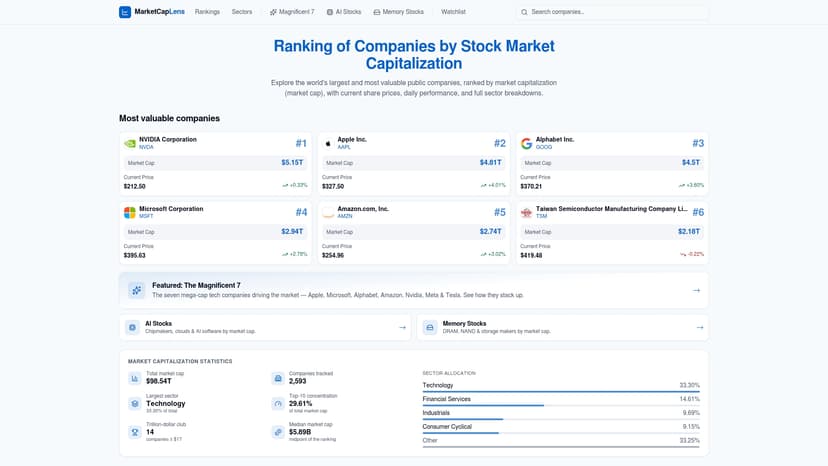
If you want to see the biggest companies across sectors in one place, our featured lists group the stocks that readers follow most, including the Magnificent 7 and AI names.
Our view: size is the start of the question
We rank companies by market capitalization because it is the one number every listed company has and every investor can compare. Aramco shows why it needs care. A company can be worth trillions of riyals and still have most of its shares in one owner’s hands.
That is why we pair rankings with sector breakdowns, historical data and plain-English explanations. A sector page tells you not just who is biggest, but how concentrated the group is, and whether the leader is pulling away or being caught.
Our approach is to refresh prices several times a day across more than 2,500 companies, so you can set a Saudi giant beside a U.S. peer on the same terms and decide for yourself what the gap means.
MarketCapLens
FAQ
What are the biggest publicly traded companies in Saudi Arabia?
Saudi Aramco is the largest by a wide margin, with a market cap of SAR 6,383,960 million on 17 November 2026. Ma’aden, Al Rajhi Bank and Saudi National Bank are among the other large names on Tadawul. For the complete order, sort the Saudi Exchange’s daily indicators report by market cap.
Is Aramco 100% Saudi owned?
Not as a listed company. Aramco’s investor FAQ says the Saudi government owns more than 81.48% of the shares. The remaining shares are held by public investors, with a 49% limit on total foreign ownership under Saudi market rules. The company was fully state-owned from 1980, according to its own history.
Is Aramco bigger than Apple?
It depends on the day and the exchange rate. Aramco’s market cap is quoted in riyals and Apple’s in dollars, so you need to convert one with a single rate and use prices from the same trading day. Run both through a market cap calculator to get a fair answer.
Which currency do Saudi market caps use?
The Saudi Exchange reports prices in Saudi riyals and market caps in SAR millions. Rankings in dollars are conversions, so their totals shift with the exchange rate the publisher chose.
Sources
- Daily Financial Indicators, Saudi Exchange
- Aramco at a glance
- Aramco: Where energy is opportunity
- Al Rajhi Bank in 2025
- About Us, Saudi National Bank
- Aramco investor FAQ
- Our history, Aramco
- Investment Climate Statements, U.S. Department of State
- Property portfolio expansion strategies
Recommended
For informational purposes only and is not investment advice. Do not rely on the facts, figures, ticker symbols, or other statements in this article — they may be incomplete, outdated, or incorrect, and we are not responsible for errors. See our disclaimer.