Price Changes and Market Cap: Why Percentages Match for Investors
By MarketCapLens · Published · 8 min read
Market cap equals the current share price times the number of shares outstanding, so when price moves, market cap moves by the same percentage as long as the share count stays constant. A stock that rises lifts its market cap by roughly the same percentage, as long as the share count stays constant. Splits, buybacks and new share issuance can change the share count, and we explain how later in this guide.
TL;DR:
- For reporting or date comparisons, use the official closing price and latest filed share count; live quotes change throughout the day, and providers may differ slightly.
- A split changes price and share count in opposite directions, leaving market cap unchanged; buybacks and new issuance affect it through count and price reactions.
- Market cap measures equity, not debt, cash, acquisition premiums, or intrinsic value; compare enterprise value or earnings multiples before treating a rise as evidence of fair pricing.
- A high share price does not mean a larger company; funds weighting stocks by market cap can concentrate exposure in the largest firms as prices rise.
MarketcaplensTrack Market Cap Alongside PriceCompare company market caps with share prices, sector breakdowns, and historical data across a database of more than 2,500 companies.Explore market data
Table of Contents
- What market capitalization is and the formula behind it
- How share-price changes affect market cap in practice
- How splits, buybacks and new issuance change market cap
- Common misconceptions: price vs market cap and market cap vs enterprise value
- Why market cap matters for investors: classification, index weighting and portfolio construction
- Worked examples and quick calculations you can do
- How to track market cap in real time and which checks to run
- Why we treat market cap as a starting point, not an answer
- Run the numbers yourself with our calculator
- FAQ
- Sources
What market capitalization is and the formula behind it
Market capitalization is the total dollar value of a company’s outstanding common shares. FINRA’s market cap explainer gives the standard formula: Market Cap = Current Share Price × Total Number of Shares Outstanding. Investor describes it the same way and notes that it works as a quick measure of company size.
Here is a worked example with illustrative inputs. Say a company trades at $50 per share and has 10 million shares outstanding. Its market cap is $50 × 10,000,000 = $500 million.
A few practical points help when you compute it yourself:
- Use the price type that matches your purpose: a live quote for a current snapshot, the official closing price for reporting.
- Use the share count from the company’s latest filings, not a rounded figure from memory.
- Published market-cap figures often rely on closing prices or official share counts, so two sites can differ slightly on the same day.
- Market cap is a perceived value. It reflects what investors are willing to pay at a given moment, not an audited number.
If you are new to the concept, our plain-English guide to market capitalization covers the basics in more detail.
How share-price changes affect market cap in practice
Because the formula is multiplication, the math is proportional. Share price is the only moving part on a normal trading day.
That is also why market cap is a dynamic estimate, not a static one. FINRA explains that share prices fluctuate during trading hours, so market cap shifts with them. Trackers refresh several times a day for this reason, and the number you see at 10 a.m. may not match the closing figure.
A 2025 research paper on the dynamic relationship between volume, price and market capitalization offers useful context for short-term swings:
The paper reports near-perfect co-movement between price changes and market-cap changes, plus a positive association between price changes and trading volume in its empirical illustrations.
In plain terms, big price moves often arrive alongside heavier trading, and market cap follows price almost one for one.
Now apply it to a portfolio. Say you own shares at a given price. A price rise increases the value of your holding, creating a paper gain that remains unrealized until you sell. Paper gains and losses stay unrealized until you sell.
How splits, buybacks and new issuance change market cap
Share-count events are where the “price moves, market cap moves” rule needs care. Some corporate actions change the count without changing total value, and some change it in ways that matter.
- Stock splits and reverse splits: FINRA’s stock-splits guidance shows that share count and per-share price change proportionally, so the total value of your holding stays the same. A split alone does not change market cap.
- Buybacks: The company repurchases its own stock, which reduces shares outstanding. Market cap changes only to the extent the price reacts to the buyback.
- New issuance: Selling new shares raises the count. Market cap rises or falls depending on how the market values the added capital and the dilution.
- Option and warrant exercises: When holders exercise, shares outstanding increases, which dilutes existing owners and feeds into the formula.
A 2-for-1 split halves the price and doubles the shares, and the market cap does not move.*
Common misconceptions: price vs market cap and market cap vs enterprise value
The biggest mistake is treating a high share price as a sign of a big company. Investopedia warns against judging a company by per-share price alone. A stock with a much higher per-share price can have a smaller market cap than a lower-priced stock if it has far fewer shares outstanding.
Market cap is also not a full valuation. Keep these distinctions in mind:
- Enterprise value adds debt and subtracts cash, so it reflects what it would take to own the whole business. Market cap captures only the equity side. Our market cap vs. enterprise value breakdown walks through the difference.
- Acquisition cost is usually higher than market cap, because buyers typically pay a premium and take on debt.
- Intrinsic value is an estimate of what a business is worth based on its fundamentals. Investopedia’s investor guide notes that market cap does not equal intrinsic value, since price is set by supply and demand.
Why market cap matters for investors: classification, index weighting and portfolio construction
Market cap sorts companies into small, mid and large buckets, and those buckets map to different risk profiles. Fidelity explains that larger companies tend to show more stable prices, while smaller companies tend to be more volatile.
Beyond sorting, market cap drives how many investors build portfolios:
- Index weighting: In a market-cap-weighted index, a company’s weight is its market cap relative to the total. When a stock rallies, its index weight rises automatically.
- Portfolio construction: Fidelity notes that fund managers and index providers use market-cap classifications, which directly affect asset flows into and out of companies.
- Passive exposure: If you hold a broad index fund, a handful of the biggest companies can account for a large share of your exposure, and that concentration grows as their prices rise.
- Allocation mix: Blending cap sizes lets you balance steadier large companies against higher-volatility smaller ones.
Worked examples and quick calculations you can do
Start with a hypothetical. A stock has 4 million shares and closes at $20, a market cap of $80 million. If the close moves to $21, the same math gives $84 million, and a drop to $19 gives $76 million. A price move changes market cap by the same percentage when the share count stays constant.
The pattern for any stock: multiply the percent price change by the starting market cap to get the dollar change.
- Convert the price change to a percentage first, then apply it to market cap.
- Confirm shares outstanding did not change in the same period.
- For real companies such as Microsoft or Meta, pull the current price and share count together, since either input alone tells you little.
How to track market cap in real time and which checks to run
Live quotes update continuously during trading hours, while official closing prices are fixed at the end of the session. That is why data providers refresh market-cap figures multiple times a day. For reporting or comparisons, closing prices give you a consistent baseline.
Run these checks before you trust a number:
- Verify whether the share count is total shares outstanding or only the float, the portion available to trade. Our explainer on shares outstanding vs. float covers why it matters.
- Prefer closing prices when comparing across dates.
- Cross-check any figure against a calculator before you act on it.
Pro Tip: If two sources disagree on a market cap, compare their share counts first. A mismatch there explains most gaps.
We built live rankings, sector views and a market-cap calculator at MarketCapLens so you can verify and contextualize these numbers in one place.
Why we treat market cap as a starting point, not an answer
Market cap is a useful, fast signal, and its real-time nature is exactly why we publish it. But it describes size, not quality or value. Before acting on a big market-cap move, pair it with at least one valuation check, such as enterprise value or earnings multiples, and ask what actually caused the price change. A rising market cap tells you what investors are paying today, not whether they are paying a fair price.
— MarketCapLens
Run the numbers yourself with our calculator
You now have the math: price times shares, and percent moves that flow straight through. For fast checks, historical lookups and sector context, a dedicated tool saves time over a spreadsheet, and we built ours for exactly that.
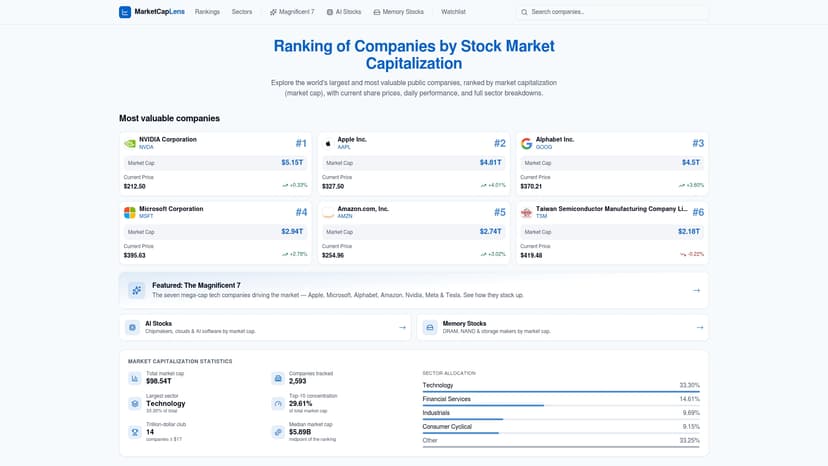
- Our market cap calculator multiplies price by shares for any scenario you want to test.
- Our live rankings show where a company sits among thousands of others as prices move.
- Our sector views place a market-cap change in its industry context.
Try your own scenario now with the Market Cap Calculator, or browse the live market cap rankings.
FAQ
What is the difference between market cap and price?
Share price is the cost of one share, while market cap is the value of all shares combined. Market cap equals price times shares outstanding, which makes it a better measure of company size than price alone.
What is price change in the stock market?
Price change is the difference between a stock’s current price and a prior price, usually shown in dollars and as a percentage. Because market cap is price times shares, the percentage change in price carries straight into market cap when the share count is unchanged.
Is it better to have a higher market cap or lower?
Neither is better by default. Larger companies tend to have steadier prices, while smaller ones tend to be more volatile, as Fidelity explains. The right mix depends on your goals and risk tolerance.
Does a stock split change market cap?
No. A split changes the number of shares and the price per share in opposite directions, so the total value stays the same, as FINRA’s stock-splits guidance shows. Market cap changes only if the price later moves for other reasons.
Recommended
For informational purposes only and is not investment advice. Do not rely on the facts, figures, ticker symbols, or other statements in this article — they may be incomplete, outdated, or incorrect, and we are not responsible for errors. See our disclaimer.