Delayed Quotes: When Individual Investors Should Pay for Live Data
By MarketCapLens · Published · 14 min read
If you need accurate prices for immediate execution, use real-time quotes; if you only monitor positions or research, delayed quotes are usually sufficient. We built MarketCapLens to give you timely price and market-cap context either way. The real tradeoff comes down to latency, cost, and execution risk, and matching that tradeoff to your trading style is critical for appropriate decisions.
TL;DR:
- Live feeds can still lag from milliseconds to a second or two, and thinly traded stocks update less consistently than heavily traded large companies.
- Free platforms commonly delay quotes by 15 to 20 minutes; check the timestamp and account agreement before placing an order that depends on current prices.
- Brokerage agreements may classify you as a professional, triggering different fees; declining the terms typically leaves you with delayed quotes rather than no data.
- Outside regular sessions, lower volume widens spreads and can cause sharp price swings, so live quotes still carry execution risk.
MarketcaplensPut Price Data in Market ContextMarketCapLens brings together share prices, market capitalization, historical data, and sector breakdowns for more than 2,500 public companies.Explore MarketCapLens
Table of Contents
- What is a real-time quote: definition, delivery pipeline, and practical limits
- What is a delayed quote: typical delay lengths and why vendors show delayed data
- How real-time and delayed quotes compare on cost, coverage, and who needs which
- How to check whether your quotes are real-time or delayed
- Subscriber agreements, exchange fees, and the professional split
- How MarketCapLens shows you near-real-time data you can verify
- Extended-hours risk and why liquidity changes the picture
- The infrastructure behind real-time and delayed price feeds
- How your quote choice affects the quality of your decisions
- Real scenarios where delayed quotes create real risk
- What regulators require around quote dissemination timing
- Our take: match the data to the decision, not the habit
- Check live prices and market hours before you trade
- FAQ
- Sources
What is a real-time quote: definition, delivery pipeline, and practical limits
A real-time quote shows the last sale price, the best bid and ask, and current volume with minimal lag between the trade happening and you seeing it. For active traders, that last sale and the depth behind it are what turn a chart into something you can actually act on.
Getting a quote from the exchange floor to your screen takes several hops, and each one adds a sliver of latency. The exchange generates the trade and quote data first, then a market-data vendor consolidates and distributes it, and finally your brokerage or charting platform renders it on your screen. Even when every hop is fast, the result is “near real-time” rather than instantaneous, and the gap can run from milliseconds to a second or two depending on the vendor’s infrastructure and your connection.
Latency also varies by provider and by asset. A heavily traded large-cap stock usually updates faster and more consistently than a thinly traded small-cap name, because order flow and quote updates arrive less frequently for illiquid securities. Sequencing matters too: two feeds can disagree for a split second simply because they received or processed the same trade in a different order. None of this makes real-time data unreliable, but it does mean “real-time” is a practical description, not a literal guarantee of zero delay, and the precision you get depends heavily on which feed and which platform you’re using.
What is a delayed quote: typical delay lengths and why vendors show delayed data
A delayed quote is exactly what it sounds like: pricing information held back before it reaches you, commonly by a typical delay of several minutes on many free financial websites and apps. That lag is standard enough that it’s worth assuming by default unless a platform tells you otherwise.
The reason so many free tools run on delayed data comes down to money. Exchanges charge redistribution fees for real-time depth and quote data, and historical SEC rulemaking on NYSE OpenBook fees shows how exchanges have structured per-terminal and subscription charges for that access. Passing real-time data to every visitor for free would be expensive, so many vendors default to delayed feeds and reserve real-time access for paying subscribers or specific account tiers.
Delayed data is genuinely fine for a large share of investing activity. If you’re checking how a long-term holding performed overnight, reviewing sector allocation, or researching a company before placing a trade tomorrow, a 15 to 20 minute lag changes nothing about the decision you’re making. The problem only shows up when the decision itself depends on the price at this exact moment.
How real-time and delayed quotes compare on cost, coverage, and who needs which
The two data types solve different problems, and the right choice depends on what you’re doing with the price, not just how much you’re willing to pay.
- Latency: real-time feeds update in near-instant fashion; delayed feeds lag by a typical delay of several minutes on most free platforms.
- Cost: delayed data is typically free; real-time access often requires a brokerage account, a market-data subscriber agreement, or a paid plan.
- Coverage and depth: real-time feeds more often include extended-hours trades and full bid/ask depth; delayed feeds usually show regular-session data only.
- Accuracy for execution: real-time data reflects the price you can actually trade at right now; delayed data reflects where the price was a quarter-hour ago, which can differ meaningfully during fast-moving sessions.
Day traders and scalpers need real-time data because their entire strategy depends on prices measured in seconds, not minutes. Swing traders benefit from it around earnings releases or other volatile events. Long-term investors, portfolio watchers, and anyone doing fundamental research can generally rely on delayed data without it affecting their outcomes, since the decisions they’re making don’t hinge on the current second.
Pro Tip: Even a real-time feed can mislead you during extended-hours sessions or in low-liquidity names, because thin order books make the “current” price swing wide between trades.
How to check whether your quotes are real-time or delayed
Most platforms give you a way to tell, but it’s not always obvious, so it’s worth running through a quick check before you trust a price enough to act on it.
- Look for a visible timestamp on the quote, plus any “real-time” badge, colored indicator, or delay disclosure the platform displays near the price.
- Compare that timestamp against a known live feed or against the actual time trades are printing on the exchange tape, if you have access to one.
- Check your brokerage account settings or your market-data subscriber agreement to confirm whether you’ve been granted real-time access or defaulted to delayed.
- Contact your platform’s support team directly if the labeling is unclear. This is especially worth doing before you rely on a quote for a time-sensitive trade.
Running this check once, when you first set up a platform or account, saves you from assuming you have live pricing when you actually don’t.
Subscriber agreements, exchange fees, and the professional split
Access to real-time data is governed by agreements between exchanges, data vendors, and the brokerages or platforms you use, and those agreements shape what you see and what it costs.
- Most brokerages require you to accept a real-time quote subscriber agreement, often a short one-time questionnaire, before unlocking live pricing on your account.
- That agreement typically classifies you as a professional or nonprofessional user, a distinction that affects pricing and sometimes which data you’re permitted to redistribute.
- Fidelity’s subscriber agreement documentation outlines how NASDAQ, NYSE, and OPRA data rights work and what happens if you decline the terms, which is usually a fallback to delayed quotes.
- Exchange fee structures for real-time depth data, documented in SEC orders like the NYSE OpenBook rule release, are the underlying reason vendors charge for or restrict access to live feeds.
If you’re unsure whether you’ll be charged, check your account’s data agreement section directly rather than assuming based on your plan tier, since professional classification can trigger fees even on an otherwise free account.
How MarketCapLens shows you near-real-time data you can verify
The platform tracks many companies and refreshes pricing and market-cap figures multiple times a day, which means you’re not relying on a single morning snapshot when researching a stock. Company pages display prices alongside sector context, so you can see where a stock sits relative to its peers without piecing that together yourself.
To verify freshness on any platform, including ours, look at the timestamp attached to the price and cross-check it against your market hours calculator to confirm whether the market was even open at that moment. If you’re comparing a live quote to a market-cap figure, our market cap calculator lets you recompute the value yourself from current price and shares outstanding, which is a useful sanity check whenever a number looks off.
Extended-hours risk and why liquidity changes the picture
FINRA defines extended-hours trading as pre-market sessions from 7 to 9:30 a.m. ET and after-hours sessions from 4 to 8 p.m. ET, with some platforms extending further into overnight trading. Outside the regular session, fewer participants are active, and that thinner volume means wider spreads and less reliable pricing.
This matters even when your data is technically real-time. A real-time quote during an illiquid after-hours window can still jump sharply between trades, because there simply aren’t enough buyers and sellers to keep the price stable. FINRA notes that lower volume in extended hours reduces order book depth, which increases execution risk regardless of how fast your data feed is.
Delayed data compounds this problem. A 15 to 20 minute old price during a volatile earnings reaction or an after-hours announcement can be wildly different from where the stock trades right now, and placing an order based on that stale number can mean a far worse fill than you expected. If you plan to trade outside regular market hours, confirm your market hours and insist on real-time data, because the margin for error from stale pricing grows exactly when liquidity is thinnest.
The infrastructure behind real-time and delayed price feeds
Every quote you see starts with raw trade and quote data generated at the exchange itself. Regulators take this timing seriously: the SEC’s MIDAS market-structure analytics system collects roughly a billion time-stamped trade and quote records daily, with precision down to the microsecond, specifically to reconstruct order books and study market events like sudden price dislocations.
From the exchange, data flows through a consolidation layer where vendors aggregate feeds from multiple exchanges into a single stream, then distribute that stream to brokerages, charting platforms, and financial websites. Each handoff in that chain, as Fidelity’s integrated subscriber agreement documentation notes, can introduce its own processing delay depending on how the vendor routes and formats the data before it reaches you.
For developers and more technical users building their own market screens or trading tools, understanding this pipeline matters for picking the right data source. Partner documentation like Darkbot’s real-time market-data integration guide walks through how exchange tickers get wired into automated systems, which illustrates the same multi-hop pattern at a technical level: raw feed, aggregation, then delivery. A platform labeling itself “real-time” has usually optimized that pipeline, but the label alone doesn’t tell you how many hops are involved or how fast each one runs.
How your quote choice affects the quality of your decisions
The quality of an investment decision depends on whether the data behind it matches the timeframe of the decision itself. For a trade you’re placing in the next thirty seconds, a stale price is actively misleading. For a decision you’re making over the next quarter, it’s irrelevant.
Real-time data improves decision quality specifically for time-sensitive calls: entering or exiting a position during a fast move, sizing an order around a specific price level, or reacting to breaking news that’s moving the stock. In those situations, even a short delay means you’re making a decision based on a price that no longer exists.
For research and long-term portfolio decisions, the accuracy of the underlying fundamentals, sector trends, and historical performance matters far more than second-to-second price precision. Reviewing a company’s market-cap trajectory, comparing it against sector peers, or checking how a stock has performed over months doesn’t change meaningfully because the price you’re looking at is 15 minutes old. The mistake isn’t using delayed data, it’s using delayed data for a decision that actually required a live price.
Real scenarios where delayed quotes create real risk
A trader watching a stock drop sharply on bad earnings news might see a delayed quote still showing the pre-announcement price, place an order expecting that level, and get filled far worse once the system catches up to the real, lower price. The 15 to 20 minute gap between what the screen shows and where the stock is actually trading is exactly the window where this kind of mismatch happens.
Another common case involves fast-moving small-cap or low-float stocks, where a sudden spike in volume can move the price substantially within minutes. Someone relying on a delayed feed might believe they’re buying near a recent low, when the live price has already moved well past that level, sometimes before the delayed quote even updates to reflect the first leg of the move.
Extended-hours trading adds another layer of risk here, since FINRA’s guidance on pre-market and after-hours sessions notes that thinner liquidity outside standard hours can cause rapid price swings. Someone checking a delayed quote before placing an after-hours order has no way of knowing the stock already gapped significantly in either direction. In each of these cases, the underlying problem is the same: the price on screen described a market that no longer exists by the time the order is placed.
What regulators require around quote dissemination timing
Quote dissemination isn’t left entirely to individual platforms to decide. Exchanges operate under SEC-approved rules that govern how market data is distributed and priced, and the SEC’s order approving NYSE’s OpenBook real-time service and fee structure is a clear example of this oversight in action, documenting how real-time depth-of-book data access and its associated per-terminal charges were reviewed and approved.
These rule releases matter because they show that access to real-time data has historically been a priced, regulated service rather than something exchanges give away freely, and that regulators weigh retail access concerns when evaluating proposed fee changes. That regulatory structure is part of why so much free market data defaults to a delay rather than real time: redistributing live exchange data without paying the associated fees isn’t something a vendor can do within the rules.
On the brokerage side, subscriber agreements like the ones Fidelity publishes for NASDAQ, NYSE, and OPRA data exist specifically to satisfy exchange requirements around who can receive real-time data and under what terms. If you decline those terms, the typical fallback is a delayed feed rather than losing access entirely, which is why checking your own agreement status is worth doing if you’re unsure what you’re actually seeing on screen.
Our take: match the data to the decision, not the habit
The rule of thumb is simple: if your trade depends on where the price is right now, pay for real-time data; if you’re researching or holding for the long term, delayed data won’t cost you anything that matters.
Where this gets people in trouble is extended-hours trading and low-liquidity names, where even real-time data can mislead you because the market underneath it is thin and jumpy. Before you place a time-sensitive order on any platform, take the few seconds to confirm whether the quote you’re looking at is actually live, rather than assuming it is because the rest of your research has been accurate.
— MarketCapLens
Check live prices and market hours before you trade
Before placing a time-sensitive order, confirm the market is actually open and your price reflects the current session. Our Market Hours Calculator shows you exactly when regular and extended sessions run, so a timestamp on any quote actually means something.
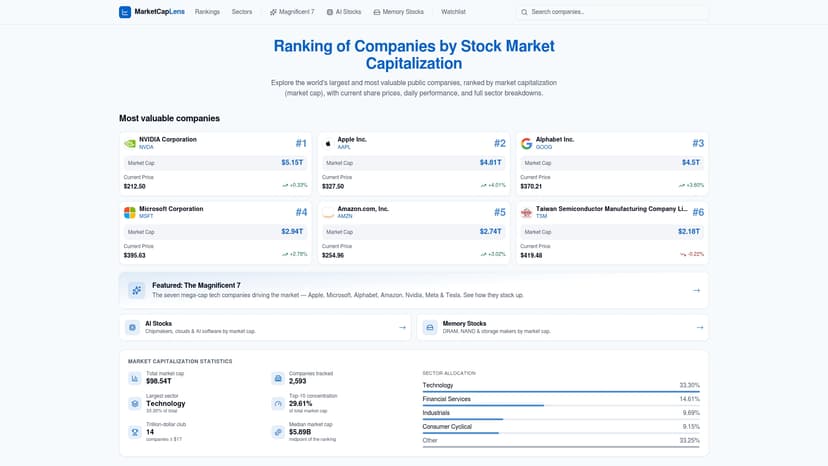
Once you’ve confirmed timing, head to our market cap rankings to see live price and market-cap context across more than 2,500 companies, or use our Market Cap Calculator to recompute a company’s valuation yourself from current price and shares outstanding. Both are free to use whenever you need a quick, verifiable check before acting on a quote.
This article is general information, not a substitute for advice from a qualified financial advisor. Consult a qualified financial professional about your own circumstances before acting on anything here.
FAQ
How accurate are after-hours stock prices?
After-hours prices reflect real trades, but FINRA notes that lower volume outside regular trading hours reduces liquidity and widens spreads, making prices swing more than they would during the regular session. Treat an after-hours quote as directionally accurate but expect more volatility around it than you’d see from 9:30 a.m. to 4 p.m. ET.
What is a real-time quote subscriber agreement?
A real-time quote subscriber agreement is a form brokerages require before granting access to live market data, often through a short questionnaire that classifies you as professional or nonprofessional. Fidelity’s agreement documentation explains that declining the terms typically means your account defaults to delayed quotes instead of losing data access entirely.
Are quotes on charting and research platforms real time or delayed?
It depends entirely on the specific platform and your account tier. Some charting tools default to delayed data unless you’ve subscribed to a real-time data package, so check for a timestamp or delay disclosure directly on the quote rather than assuming based on the platform’s reputation.
What is the professional versus nonprofessional classification in market data?
This classification determines how exchanges and vendors price access to real-time market data, with professional users, typically those using data for business purposes, generally facing different fees or terms than individual retail investors. The classification itself doesn’t usually restrict access, but it does affect what you may be charged under your data agreement.
When is delayed data good enough for investing decisions?
Delayed data, commonly lagging a typical delay of several minutes, works fine for long-term investing, portfolio monitoring, and fundamental research where the exact price at this second doesn’t change your decision. It becomes a problem only when you’re placing a time-sensitive trade that depends on the current, executable price.
Sources
- FINRA — Extended-hours trading
- Investopedia — Real-time quote (RTQ)
- SEC — Order approving real-time OpenBook service and fees (Rel. No. 34-53585)
- Fidelity — Real-time quotes subscriber agreement
Recommended
For informational purposes only and is not investment advice. Do not rely on the facts, figures, ticker symbols, or other statements in this article — they may be incomplete, outdated, or incorrect, and we are not responsible for errors. See our disclaimer.