Practical Sector Allocation for Investors: 3–5 ETF Starter Plans
By MarketCapLens · Published · 14 min read
Sector allocation strategies are methods for dividing a portfolio among industry groups, such as technology, health care, or energy to manage risk and pursue returns. The practical recommendation for most investors is a strategic core built on broad index funds, paired with limited, rules-based sector tilts, classified using the Global Industry Classification Standard (GICS) and monitored through tools like MarketCapLens.
TL;DR:
- Most investors should stick with a strategic core and a small tactical overlay to balance simplicity and responsiveness to market signals.
- Sector classification relies on the GICS standard, which is periodically updated, affecting fund compositions and sector exposure.
- A portfolio of up to five sector ETFs plus a core fund suits accounts under $50,000, while larger accounts can support more nuanced sector overlays.
- Monitoring sector weights regularly, checking for overlapping holdings, and using data tools like MarketCapLens help prevent unintended concentration.
- Quarterly rebalancing with threshold triggers offers a practical balance between staying aligned and minimizing taxable trading.
Marketcaplensmarketcaplens.comTrack Sector Trends With Clearer DataMarketCapLens brings together market capitalization, share prices, sector breakdowns, historical data, and performance metrics in one view.Explore MarketCapLens
Table of Contents
- 1. Main sector allocation strategy types and when to use each
- 2. How sectors are defined and why GICS shapes your allocation
- 3. Building a portfolio: core-satellite blueprints and starter templates
- 4. Tactical rotation and monitoring: signals, cadence, and cost trade-offs
- 5. Checking for hidden concentration across your funds
- 6. Using MarketCapLens to monitor and refine sector allocations
- 7. Historical performance and risk characteristics of different strategies
- 8. The role of sector allocation in diversification and risk management
- 9. How the economic cycle shapes sector decisions
- 10. Common pitfalls and behavioral biases to watch for
- 11. Case studies: adjusting sector allocation across market conditions
- 12. Author perspective: a case for simplicity over active rotation
- Quick steps to monitor your sector allocation
- FAQ
- Sources
1. Main sector allocation strategy types and when to use each
FINRA groups common approaches into six categories, and knowing which one fits your situation matters more than picking the best capital allocation in finance in the abstract. The SEC’s asset allocation guidance frames allocation as the first decision investors make, before stock-picking or timing, because it drives most of the variation in long-term portfolio outcomes.
- Strategic allocation sets fixed target weights by sector or asset class and holds them for years, adjusting only through periodic rebalancing.
- Constant-weighting allocation keeps sector percentages fixed by buying and selling as prices drift, a disciplined version of strategic that trades more often.
- Tactical allocation shifts sector weights temporarily to exploit short-term opportunities, then reverts to the strategic baseline.
- Dynamic allocation continuously adjusts weights based on changing market conditions and economic outlook rather than a fixed revert point.
- Insured allocation sets a floor value below which the portfolio cannot fall, shifting into defensive sectors or cash when that floor is threatened.
- Integrated allocation combines several of the above, weighing market forecasts, risk tolerance, and goals together rather than following one rule in isolation.
FINRA’s overview of these strategies notes that each one carries different monitoring demands. Strategic and constant-weighting suit investors with limited time to watch markets and a preference for predictable tax outcomes, since trades happen on a schedule rather than in reaction to news. Tactical and dynamic approaches demand more attention, often weekly or monthly, and tend to generate more taxable events in a standard brokerage account. Insured strategies fit investors nearing a specific goal, such as retirement, who need to protect principal more than chase growth. Integrated approaches work best for professionals or disciplined individual investors who can hold several variables in mind at once without letting any single signal dominate decisions.
For most individual investors, the practical starting point is strategic with a small tactical overlay: a core that barely moves, plus a slice that can respond to clear signals without threatening the whole portfolio if the signal is wrong.
2. How sectors are defined and why GICS shapes your allocation
Sector classification only works as a planning tool when everyone uses the same map. The Global Industry Classification Standard is that map for most of the fund industry, dividing the market into 11 sectors that sit above narrower industry groups and sub-industries.
- Energy, covering oil, gas, and consumable fuels production and equipment.
- Materials, including chemicals, metals, mining, and paper products.
- Industrials, spanning aerospace, machinery, transportation, and construction.
- Consumer Discretionary, covering autos, retail, and leisure goods.
- Consumer Staples, including food, beverage, and household products.
- Health Care, covering pharmaceuticals, biotech, and medical equipment.
- Financials, including banks, insurance, and capital markets firms.
- Information Technology, spanning software, hardware, and semiconductors.
- Communication Services, covering telecom, media, and entertainment.
- Utilities, including electric, gas, and water providers.
- Real Estate, covering REITs and real estate management companies.
Standardization matters because GICS periodically reclassifies companies as their business mix changes, and that reshuffling changes what a “sector fund” actually holds. A company that moves from Consumer Discretionary to Communication Services, for instance, pulls its market weight out of one sector ETF and into another overnight, which can shift the realized sector exposure of investors who assumed their holdings were stable. When reading a fund prospectus, check which classification system it uses and how recently sector weights were updated. You can see how MarketCapLens groups companies by sector and market-cap rank on its sector classification page, which mirrors the same 11-sector logic fund managers rely on.
3. Building a portfolio: core-satellite blueprints and starter templates
This structure caps the damage a wrong tactical call can do, since the bulk of the portfolio keeps moving with the broad market regardless of how the satellite performs.
Portfolio size changes how many moving parts make sense. A larger account can absorb more positions without each one becoming too small to matter or too costly to rebalance.
- A $10,000 starter portfolio works best with one broad core fund plus two or three sector ETFs, since splitting further creates positions too small to rebalance efficiently.
- A $50,000 portfolio can support a core fund plus four or five sector tilts, giving enough room to express a couple of distinct views without over-fragmenting.
- A $250,000 portfolio has the scale to run a full 11-sector satellite sleeve alongside the core, effectively building a custom sector-weighted overlay, though this requires more monitoring time than most individual investors want to commit.
Execution logistics matter as much as the target weights. Buy the core position first so the bulk of the money is working in the market immediately, then layer in satellite tilts over the following days or weeks rather than all at once. Fractional-share brokers make it easier to hit precise target weights in a small account without leaving uninvested cash sitting on the sidelines. Order of operations also affects taxes: in a taxable account, build new positions with new contributions before selling existing ones, so you avoid triggering gains just to rebalance.
Pro Tip: Keep your satellite sleeve to no more than four or five sector ETFs at first. Every added position increases the monitoring burden without necessarily improving diversification once you already hold a broad core.
4. Tactical rotation and monitoring: signals, cadence, and cost trade-offs
Running a tactical or dynamic tilt without a monitoring routine usually just adds cost and noise. The discipline is in the cadence, not the cleverness of the signal.
- Momentum signals look at which sectors have outperformed over the trailing three to twelve months, under the premise that strength tends to persist in the near term.
- Valuation signals compare a sector’s price-to-earnings or price-to-book ratio against its own history to flag when it looks stretched or cheap.
- Macro signals track interest rate direction, inflation trends, and business cycle stage, since different sectors historically respond differently to each.
CFA Institute practitioner guidance points to monthly signal checks paired with quarterly rebalancing as a common monitoring rhythm, one that is frequent enough to catch meaningful shifts without triggering constant trading. Calendar rebalancing, resetting weights every quarter or year regardless of how far they have drifted, is simple and predictable. Threshold rebalancing, resetting only when a sector weight drifts a set amount, often five percentage points, from its target, reacts faster to large moves but requires more frequent checking.
Before adding a cadence, weigh it against turnover and tax impact. Practitioner research warns that frequent tactical rotation can generate turnover and tax drag that outweighs whatever edge the rotation signal provides, particularly in a taxable account where every rebalance can trigger a capital gain. A quarterly threshold check, rather than constant tinkering, usually strikes the better balance for an individual investor managing their own account.
5. Checking for hidden concentration across your funds
Owning several sector ETFs does not automatically mean you are diversified. FINRA’s concentration risk guidance warns that overlapping holdings across different funds can quietly rebuild the exact concentration an investor thought they had avoided.
- Pull the top-10 holdings from each fund’s prospectus or fact sheet and list them side by side.
- Flag any company appearing in multiple funds and add up its combined weight across your whole portfolio.
- Check sector weights for each fund, not just its name, since a “technology” fund can carry meaningful weight in communication services or consumer names that behave like tech.
- Run a basic correlation check between your satellite positions, since two sector ETFs with different names can still move almost identically if their top holdings overlap.
- Set a hard cap, commonly 5% to 10% of total portfolio value, on exposure to any single company, and a similar cap on any single sector outside your intentional tilt.
FINRA’s asset allocation and diversification overview frames this as “looking under the hood” rather than trusting a fund’s label. A tech-heavy market-cap-weighted ETF and an explicit technology sector fund can hold several of the same top names, meaning an investor holding both is less diversified than the fund count suggests. Rebalancing on a set schedule and spreading exposure across market-cap sizes, not just sectors, are the two most reliable levers for pulling concentration back down once you find it.
6. Using MarketCapLens to monitor and refine sector allocations
Building a sector allocation is one task, keeping it honest over time is another, and that is where live data earns its place in the process. MarketCapLens tracks sector breakdowns and market-cap rankings across thousands of companies, which gives you a running check against the static weights in a prospectus you read six months ago.
- Check the sector breakdown page to see current weights across all 11 GICS sectors ranked by combined market cap.
- Scan top contributors within a sector to identify which specific companies are driving a sector’s recent move, rather than reacting to the sector label alone.
- Compare five-year returns by sector, as illustrated on the AI stocks returns page, to see how a theme performs over a full cycle rather than a single quarter.
- Revisit the sector definitions page whenever a fund’s prospectus references GICS classifications you want to double-check.
None of this replaces reading a fund’s prospectus, but it adds a live layer on top of that document’s point-in-time snapshot, which is useful for the tactical signal checks described earlier.
7. Historical performance and risk characteristics of different strategies
Strategic and constant-weighting approaches tend to track the broad market closely over long periods, since they rarely deviate far from a fixed target. Their main risk is opportunity cost: they will not capture a sector’s unusual run, but they also will not get caught overexposed when that run ends. Tactical and dynamic strategies can add return in periods when sector leadership is persistent and identifiable, but their results are uneven, since a wrong call compounds the cost of both the missed opportunity and the trading expense of unwinding it. Insured strategies trade upside for downside protection by design, which suits an investor with a hard floor to protect but tends to lag in strong bull markets. Integrated strategies, by combining signals, often produce smoother results than a single-signal tactical approach, though they are harder to execute consistently without institutional resources. Across all six models, the FINRA framework stresses that monitoring discipline and rebalancing consistency explain more of the difference in long-term outcomes than the specific model chosen.
8. The role of sector allocation in diversification and risk management
Sector allocation is one layer of diversification, sitting alongside asset class, geography, and market-cap size. The SEC’s guidance on asset allocation describes diversification as spreading investments within a category, and sectors are the natural subdivision within equities. Because sectors respond differently to the same economic conditions, interest rate changes that hurt financials can leave utilities largely unaffected, holding several sectors reduces the odds that one shock to a single industry drags down the whole portfolio. This does not eliminate risk; a broad market downturn still affects most sectors to some degree. What it controls for is idiosyncratic sector risk, the kind tied to a single industry’s regulatory, commodity, or technological disruption. A portfolio concentrated in one or two sectors, even unintentionally through overlapping fund holdings, loses this protection regardless of how many individual tickers it holds.
9. How the economic cycle shapes sector decisions
Different sectors have historically led and lagged at different points in the business cycle, which is the core logic behind dynamic and tactical allocation. Early-cycle recoveries have tended to favor financials and consumer discretionary names as credit conditions ease and spending picks up. Late-cycle expansions have often favored energy and materials as demand pressures push commodity prices higher. Slowdowns and contractions have tended to favor defensive sectors like utilities, consumer staples, and health care, where demand holds up regardless of broader economic conditions. Interest rate policy adds another layer: rate increases tend to pressure rate-sensitive sectors like real estate and utilities, while benefiting financials through wider lending margins. None of these patterns repeats identically every cycle, and acting on a cycle read requires accepting that the signal can be early, late, or simply wrong. This is why the tactical overlay in a core-satellite structure is sized small: it lets an investor act on a macro view without betting the whole portfolio on reading the cycle correctly.
10. Common pitfalls and behavioral biases to watch for
The most common mistake is chasing recent performance, buying into last year’s winning sector just as its momentum fades, rather than following a pre-set signal. Recency bias drives this: investors tend to overweight what just happened and underweight the possibility of reversion. A second pitfall is home bias within sectors, sticking with familiar industries, like technology for investors who work in tech, rather than building exposure based on valuation or diversification logic. A third is skipping the overlap check described earlier, assuming that holding five different ETFs means five times the diversification, when several may share the same dominant holdings. The fix for all four is the same: written rules for position sizing and rebalancing triggers, decided in advance, so decisions get made by the plan rather than by the emotion of the moment.
11. Case studies: adjusting sector allocation across market conditions
Consider an investor running a strategic core with a tactical energy tilt added when the sector’s valuation looked historically cheap relative to its own trailing average. If a threshold rule, say rebalancing once the tilt drifts five percentage points above target, sits behind that position, the investor trims it mechanically as it runs rather than letting it balloon into an outsized bet. Compare that to an investor who added the same tilt but kept extending it as prices rose, chasing continued strength; the second investor now carries concentration risk the first one avoided purely through rule-following. In a slowdown scenario, an investor using an insured strategy might shift satellite weight from consumer discretionary into consumer staples and utilities as a defensive move, accepting lower upside in exchange for a protected floor. These are not predictions about what any sector will do next; they illustrate how the same core-satellite structure plays out differently depending on whether rebalancing rules are followed or abandoned mid-cycle.
12. Author perspective: a case for simplicity over active rotation
Most individual investors overestimate how much value tactical rotation will add and underestimate how much time and tax discipline it demands. Unless you can commit to a monitoring cadence and genuinely absorb the trading and tax costs, a strategic core with small, rules-based tilts will likely serve you better than frequent sector rotation. Consistency beats cleverness here: the rules you actually follow for years matter more than the signal that looked sharp for one quarter.
— MarketCapLens
Quick steps to monitor your sector allocation
Once your allocation is set, the ongoing work is watching sector weights drift and catching concentration before it becomes a problem, and a data platform can help with this. Some platforms track real-time sector breakdowns and market-cap rankings across thousands of companies, updated multiple times daily, giving you a live reference to check against your target weights.
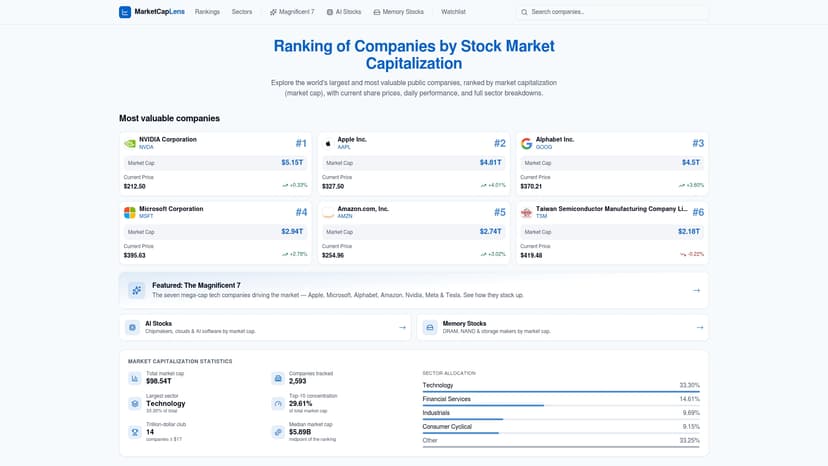
Start with the sector breakdown page to see current weights across all 11 sectors, then read the sector definitions guide if you want the classification logic behind those numbers before your next rebalance.
FAQ
What is Warren Buffett’s 70/30 rule?
It is a broad asset-class split rather than a sector allocation method, though an investor could apply sector tilts within the 70% equity portion.
What are the four main asset allocation strategies?
Definitions vary across sources, but FINRA’s framework lists six common approaches: strategic, constant-weighting, tactical, dynamic, insured, and integrated allocation. Some commentators narrow this to four by grouping constant-weighting with strategic and insured with dynamic, but there is no single universally cited four-category standard.
What is Dave Ramsey’s asset allocation strategy?
This figure is not publicly documented in the regulatory or research sources this article relies on. Readers looking for a specific commentator’s allocation formula should consult that source directly rather than a secondhand summary.
What are allocation strategies?
Allocation strategies are methods for dividing a portfolio among asset classes or sectors to manage risk and pursue return goals. The SEC’s investor guidance describes allocation as the decision that most determines a portfolio’s reaction to market swings, separate from individual security selection.
How often should I rebalance a sector allocation?
A common approach uses calendar rebalancing every six to twelve months, as described in SEC investor guidance, combined with threshold checks that trigger a rebalance when any sector drifts meaningfully from its target. Checking monthly and rebalancing quarterly is a practical middle ground for most individual investors managing sector tilts.
Sources
- Asset allocation: Investor.gov (SEC)
- Asset allocation and diversification — FINRA
- Industry classification methods — AnalystPrep (CFA-level primer)
Recommended
For informational purposes only and is not investment advice. Do not rely on the facts, figures, ticker symbols, or other statements in this article — they may be incomplete, outdated, or incorrect, and we are not responsible for errors. See our disclaimer.