Why Stock Splits Leave Market Cap Unchanged for Investors, SEC Proof
By MarketCapLens · Published · 9 min read

A stock split, forward or reverse, does not by itself change a company’s market capitalization. The math is inverse and immediate: shares outstanding go up (or down), price per share moves the opposite way by the same ratio, and the product stays fixed. Everything else in this article is the mechanics, the proof, and what actually matters for your portfolio when a split hits the news.
TL;DR:
- Stock splits do not affect a company’s market capitalization because share count and share price move inversely by the same ratio.
- Reverse splits are often a sign of operational distress or a response to minimum price rules, especially if they occur repeatedly over a short period.
- Dividends and options are adjusted proportionally after splits, but a split does not influence the company’s fundamental financial health.
- Investors should review detailed official filings and broker policies rather than rely on split announcements alone to understand the implications for their holdings.
- Marketcaplens provides split-adjusted market cap histories to accurately track valuation trends and distinguish real growth from share count increases.
MarketcaplensTrack Market Cap Beyond Stock SplitsCompare split-adjusted market cap histories, share prices, sector breakdowns, and trends across thousands of public companies.Explore MarketCapLens
Table of Contents
- Stock Split Market Cap Mechanics: How Forward and Reverse Splits Work
- Why Market Capitalization Stays the Same: The Math
- Why Companies Split Stock, and What It Signals for You
- Reverse Splits: Red Flags, Exchange Rules, and Delisting Risk
- How Splits Affect Dividends, Options, and Other Securities
- What to Do When a Company Announces a Split
- How Marketcaplens Handles Split-Adjusted Market-Cap Data
- See Split-Adjusted Market Cap Charts and Company Histories
- Sources
- FAQ
Stock Split Market Cap Mechanics: How Forward and Reverse Splits Work
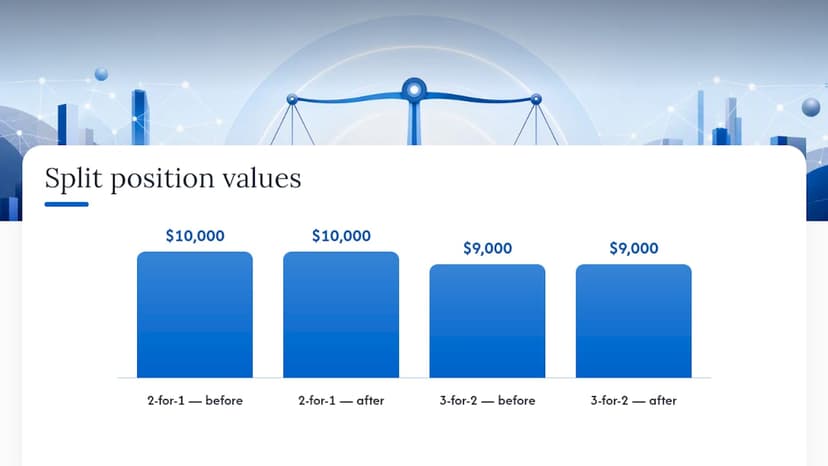
A forward split multiplies your share count and divides the price by the same factor. In a 2-for-1 split, 100 shares at $100 become 200 shares at $50. A 3-for-2 split turns 100 shares at $90 into 150 shares at $60. Either way, your position’s dollar value doesn’t budge.
A reverse split runs the operation backward. A company might do a 1-for-10 reverse split to lift a $2 stock to $20, usually to satisfy an exchange’s minimum price rule. Nasdaq and the NYSE both require listed companies to keep their share price above a set floor, and a reverse split is the fastest fix available to a struggling issuer.
The timeline matters for anyone tracking positions closely:
- Announcement date. The company files an 8-K or press release naming the ratio and rationale.
- Record date. The company snapshots who owns shares to determine who gets adjusted.
- Ex-date. Shares begin trading at the new, split-adjusted price.
- Effective date. The legal date the new share count and CUSIP (the identifier your broker uses to track the security) take hold.
Fractional shares get rounded, paid out in cash, or credited depending on your broker’s policy, so check your account’s corporate-actions notice rather than guessing.
Why Market Capitalization Stays the Same: The Math
Market cap is shares outstanding multiplied by price per share. Split a company’s shares by a factor of n, and its price divides by that same n. Multiply the two together and n cancels out completely.
Run the numbers on a real-looking example:
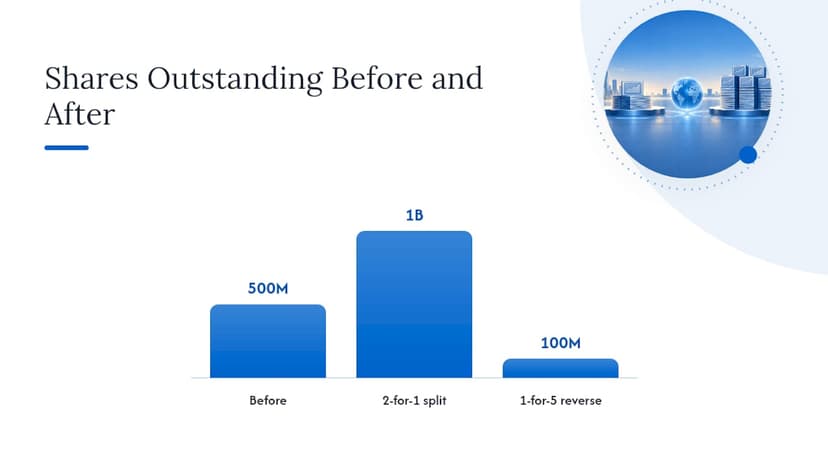
- Before: 500 million shares × $200 = $100 billion market cap.
- After a 2-for-1 forward split: 1 billion shares × $100 = $100 billion market cap.
- After a 1-for-5 reverse split instead: 100 million shares × $1,000 = $100 billion market cap.
The market cap doesn’t move a dollar in either direction from the split mechanics alone. FINRA’s investor education page confirms the same point: shares outstanding and price adjust inversely, leaving valuation untouched. The SEC’s own explainer walks through equivalent examples for readers who want to see the arithmetic from the regulator’s side.
None of this rules out the stock actually moving that day. Investors sometimes bid a stock up or down around a split announcement, but that’s sentiment and trading activity layered on top of a mechanical event, not a consequence of the split itself.
Why Companies Split Stock, and What It Signals for You
Companies pursue forward splits for a handful of recurring reasons:
- Lowering the per-share price to make shares feel more affordable to retail buyers.
- Increasing share count to improve trading liquidity and tighten bid-ask spreads.
- Hitting a psychological price point that management believes attracts more buyers.
None of that changes revenue, margins, or cash flow. A split is bookkeeping and optics, not a fundamental catalyst, as Fidelity’s investor education content points out.
That said, split announcements do sometimes cluster with periods of investor optimism. Some historical data shows a pattern of one to three years of relative outperformance following forward splits, but that correlation doesn’t prove the split caused it. Companies healthy and confident enough to split often were already performing well beforehand.
Pro Tip: Treat a split announcement as one data point among many, not a buy signal on its own. Check the company’s revenue trend, margins, and debt load before assuming the split means anything about future returns. If you want to see how a stock’s valuation trended before and after a past split, MarketCapLens’ explainer on what moves market cap breaks down the real drivers.
Reverse Splits: Red Flags, Exchange Rules, and Delisting Risk
Reverse splits usually happen for one blunt reason: the stock price has fallen low enough to threaten the company’s listing. Exchanges set minimum price thresholds, and a reverse split is the quickest legal way to clear that bar without raising new capital.
That’s exactly why a reverse split deserves more scrutiny than a forward one. Watch for these patterns:
- Multiple reverse splits within a few years, which often signals a business that keeps losing ground rather than recovering.
- A reverse split filed alongside other distress signals, like auditor warnings, executive departures, or covenant breaches in debt filings.
- Announcements that arrive with little operational context beyond “maintaining listing compliance.”
Investor worth researching before you buy or hold through one. If you see a pattern of repeated reverse splits, read the filings before assuming the worst, but lean conservative with position sizing.
How Splits Affect Dividends, Options, and Other Securities
Dividends adjust proportionally along with your share count. If you held 100 shares paying a $1 per-share quarterly dividend before a 2-for-1 split, you’ll hold 200 shares paying $0.50 each afterward. Your total dividend income is unchanged unless the board separately votes to raise or cut the payout.
Options and other listed derivatives get adjusted too, and the Options Clearing Corporation and exchanges publish formal notices covering exactly how. A handful of practical points to know:
- Strike prices and contract multipliers adjust so the economic value of an existing options position doesn’t change.
- In a straightforward split, contract counts and strikes typically scale by the same ratio as the underlying shares.
- ADRs and foreign-listed shares can follow different adjustment timing depending on the depositary bank, so don’t assume US rules apply automatically.
- Fractional shares from a split are commonly settled as cash-in-lieu rather than a partial share credit.
Always confirm the exact adjustment through your broker’s corporate-actions notice or the official OCC memo rather than estimating it yourself.
What to Do When a Company Announces a Split
A split announcement is a good moment for a quick account check, not a trading decision.
- Read the filing. Confirm the ratio, record date, ex-date, and effective date directly from the company’s press release or 8-K rather than a secondhand summary.
- Check your broker’s fractional-share policy. Log in after the effective date to confirm your new share count matches expectations.
- Reassess fundamentals, not the split. A lower share price doesn’t make a stock cheaper in any meaningful sense; look at earnings, revenue growth, and valuation multiples instead.
- Confirm options adjustments. If you hold contracts on the underlying stock, check your broker’s corporate-actions page or the OCC notice for the exact new terms.
Pro Tip: Give your brokerage 24 to 72 hours after the effective date before trusting your account’s post-split numbers completely. CUSIP changes and index-provider updates sometimes take a little time to fully propagate through broker systems.
How Marketcaplens Handles Split-Adjusted Market-Cap Data
The platform builds split-adjusted price histories into every company profile, tagging each entry with the split ratio, effective date, and CUSIP notes where relevant. That metadata matters more than it sounds: without it, a market-cap chart spanning a multi-for-one split looks like a cliff, when nothing about the company’s actual value changed.
Tracking thousands of listed companies with data refreshed multiple times daily, the service keeps historical comparisons intact even when a company’s share count has shifted several times over the years. If you want to see how a specific company’s valuation actually trended through past corporate actions, company pages and learning resources lay out the adjusted numbers side by side, not just the raw headline price.
— MarketCapLens
See Split-Adjusted Market Cap Charts and Company Histories
If you’re trying to figure out whether a company’s valuation actually grew or just got sliced into more shares, a raw price chart won’t tell you. Marketcaplens is built specifically to answer that question, showing split-adjusted market-cap trends and full company histories rather than making you reconstruct the math from old filings yourself.
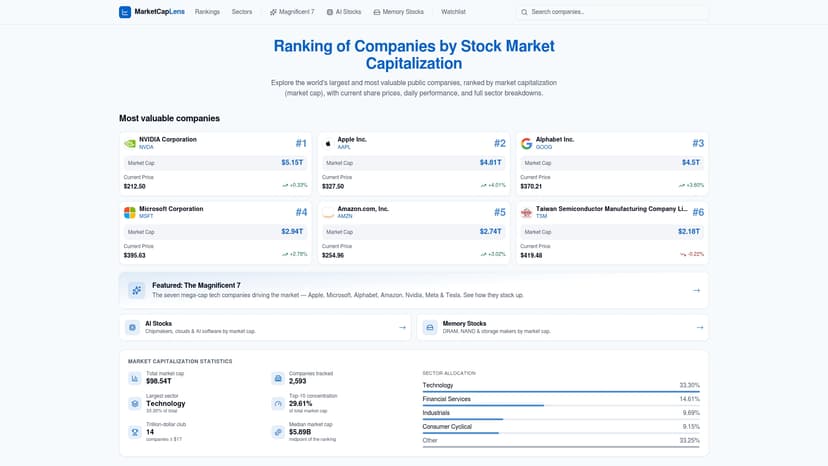
Every one of the more than 2,500 companies tracked on the platform carries its market-cap history alongside sector context, so you can see how a stock’s true valuation moved before and after any split, name change, or share consolidation. Start with the market cap rankings on Marketcaplens to browse companies by size and sector, or read the plain-English guide to market capitalization if you want the full definition before you dig into individual charts. If you also trade options around corporate actions, a dedicated trading journal and analytics platform can help you track how adjustments affect your open positions over time.
Sources
For the official record, read FINRA’s stock split guidance, the SEC’s stock split FAQ, and Investor.gov’s page on reverse stock splits. For a real example of split disclosure language, see this representative 8-K filing on EDGAR. Always check the issuer’s investor-relations page and EDGAR for the actual announcement before acting on secondhand summaries.
FAQ
Does a Stock Split Change a Company’s Market Cap?
No. A split changes the number of shares outstanding and the price per share by the same inverse ratio, so market capitalization stays the same immediately before and after the mechanical event.
What Happens to 100 Shares After a 2-for-1 Stock Split?
A shareholder with 100 shares would hold 200 shares after a 2-for-1 split, each worth roughly half the pre-split price. Total position value stays the same, aside from any market movement unrelated to the split itself.
Is It Good to Buy a Stock Right After It Splits?
A split alone doesn’t make a stock cheaper or more valuable in any fundamental sense, so buying purely because of split news skips the real question. Some data shows periods of outperformance following past splits, but Fidelity’s research notes that correlation doesn’t establish that the split caused the gains, so check earnings and valuation before deciding.
Who Owns Most of the Stock Market Today?
Institutional investors, including pension funds, mutual funds, and index funds, hold the majority of publicly traded US equities rather than individual retail investors. Retail participation has grown through brokerage apps and ETFs, but institutions still control the largest share of aggregate market value.
What Stocks Might Split Soon?
Companies don’t announce splits far in advance, and Marketcaplens does not maintain speculative split forecasts. The most reliable way to track upcoming splits is watching company press releases and SEC filings directly, or checking a company’s market cap and stock price page on Marketcaplens for the latest corporate-action updates.
Recommended
For informational purposes only and is not investment advice. Do not rely on the facts, figures, ticker symbols, or other statements in this article — they may be incomplete, outdated, or incorrect, and we are not responsible for errors. See our disclaimer.