Trading Halts: Why Stocks Stop and How They Resume
By MarketCapLens · Published · 11 min read
A trading halt is a temporary stop in trading of one stock, or of the whole market, and it ends when the exchange that lists the stock says it ends. In the U.S., a halt typically lasts less than an hour and is called to let a company release important news or to work through a large imbalance between buyers and sellers. While it lasts, no U.S. market may trade the stock. If you track thousands of companies by market cap, as we do at MarketCapLens, you will see halted names stall in your rankings. Knowing the reason code tells you whether to worry or just wait.
MarketcaplensKeep Market Moves in ContextTrack company performance, market trends, historic data, and sector allocations across more than 2,500 public companies.VisitTL;DR
- A halt pauses trading in a stock on every U.S. market, including off-exchange trading. Brokers cannot publish quotes or trade it during the halt.
- Main causes: pending or just-released news, extraordinary activity, a price move beyond set limits, regulatory concerns and SEC trading suspensions of up to 10 business days.
- The code attached to a halt (T1, T2, T5, T12, LUDP, H10 and others) tells you the reason.
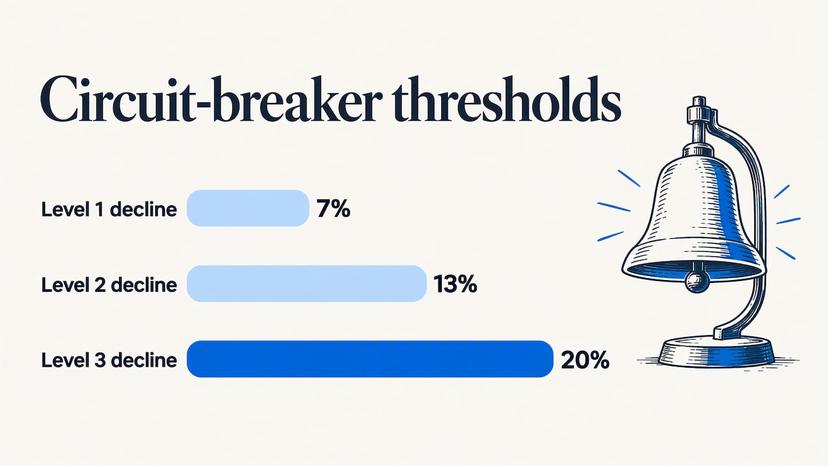
- Market-wide circuit breakers fire when the S&P 500 falls 7%, 13% or 20% from the prior close.
- Check live halts on the exchange’s own halt list, then watch the resume time before you act.
Table of Contents
- What a trading halt means
- Why stocks get halted
- Trading halt codes and what they signal
- Market-wide circuit breakers
- How long a halt lasts and how trading resumes
- What happens to your orders during a halt
- How to check which stocks are halted right now
- Where MarketCapLens fits
- Our perspective
- FAQ
- Sources
What a trading halt means
A halt stops all buying and selling in a security for a period. According to FINRA’s investor guide on trading halts, every other U.S. market that trades the stock must observe the halt, including off-exchange trading in the over-the-counter market. Brokerage firms are also prohibited from publishing quotations or indications of interest and from trading the stock while the halt is in effect.
Two terms help here. The listing exchange is the exchange where the company’s shares are officially listed, such as the NYSE or Nasdaq. A regulatory halt is a halt the listing exchange declares for news, order imbalances or similar reasons. Under FINRA Rule 6120, a regulatory halt starts when the primary listing market declares it. Trading resumes on that market’s notice that the halt has ended, or at the resume time named in the notice.
The phrase “halted stock” therefore means one thing: you cannot trade it anywhere until the halt lifts. The price you last saw is the last price that traded, and it may not be close to where the stock reopens.
Why stocks get halted
There are five common reasons, and each one has a distinct profile.
News pending or released
Companies listed on a U.S. exchange must notify the listing exchange about developments that could affect trading before they announce them publicly. FINRA explains that the exchange then decides, based on its evaluation of the announcement, whether to halt trading. A merger, a trial result, an earnings surprise or an executive change can all qualify. The halt gives everyone time to read the news before anyone trades on it.
Order imbalances and extraordinary activity
When buy and sell orders are badly lopsided, an exchange can stop trading until it finds a fair reopening price. Nasdaq lists this as code T6, extraordinary market activity.
Volatility pauses (limit up/limit down)
This is the most common halt for large, liquid stocks. Under the NYSE’s Plan to Address Extraordinary Market Volatility, each stock has an upper and a lower price band around a reference price. For a Tier 1 stock priced above $3.00, the band is 5% either side. For a Tier 1 stock between $0.75 and $3.00 it is 20%. Between 9:30 a.m. and 9:45 a.m. ET and between 3:35 p.m. and 4:00 p.m. ET, the plan doubles the bands.
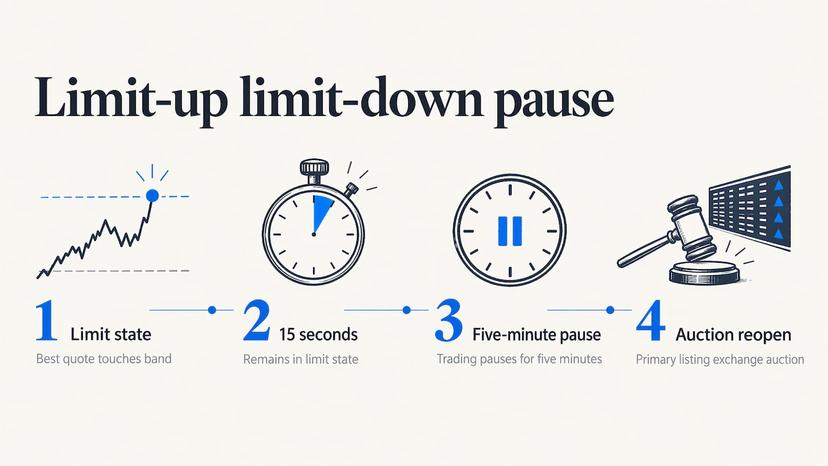
Here is how it plays out, per Cboe’s Limit Up/Down FAQ. A stock enters a “limit state” when the best offer touches the lower band or the best bid touches the upper band. If it stays there for 15 seconds, it enters a five-minute trading pause and reopens with an auction on its primary listing exchange.
Regulatory and listing concerns
Exchanges can also halt a stock when the company has not met listing requirements, has not filed current reports or when regulators have concerns. These show up as H-codes in the table below.
SEC trading suspensions
This is a different tool from an exchange halt. The SEC can suspend trading in any stock for up to 10 business days when it believes the investing public may be at risk. Typical circumstances in the SEC’s bulletin include a lack of current, accurate or adequate information about the company, doubts about the accuracy of public information on its operations or finances, and questions about trading in the stock, such as insider trading or possible manipulation.
Trading halt codes and what they signal
Every halt on Nasdaq’s list carries a reason code. These are the ones you will meet most often, taken from Nasdaq’s trading halt code page:
| Code | Meaning | What it usually tells you |
|---|---|---|
| T1 | Halt, news pending | Company news is about to come out |
| T2 | Halt, news released | News is out; the market is digesting it |
| T5 | Single stock trading pause (10% or more move in five minutes) | A sharp price swing triggered a pause |
| T6 | Halt, extraordinary market activity | Unusual trading, not tied to one announcement |
| T8 | Halt, ETF | Applies to an exchange-traded fund |
| T12 | Halt, additional information requested | The exchange wants more from the company |
| H4 | Halt, non-compliance | A listing requirement was not met |
| H9 | Halt, not current | The company is behind on required filings |
| H10 | Halt, SEC trading suspension | The SEC has suspended trading |
| H11 | Halt, regulatory concern | Regulators have raised a concern |
| LUDP | Volatility trading pause | A limit up/limit down band was hit |
| MWC1, MWC2, MWC3 | Market-wide circuit breaker, Level 1, 2, 3 | The whole market is halted |
A reading shortcut: T1 and T2 are about information, LUDP and T5 are about price, and H-codes are about compliance or regulators. The H-codes tend to run longest because they depend on a company or regulator acting, not on a clock.
Market-wide circuit breakers
A circuit breaker halts every listed stock at once. FINRA’s guide to market volatility guardrails says the triggers are measured by the decline in the S&P 500 Index from the previous day’s close:
| Level | S&P 500 decline | Effect |
|---|---|---|
| Level 1 | 7% | 15-minute halt in all listed stocks if before 3:25 p.m. |
| Level 2 | 13% | 15-minute halt in all listed stocks if before 3:25 p.m. |
| Level 3 | 20% | Trading suspended for the rest of the day, at any time |
A Level 1 or Level 2 decline at or after 3:25 p.m. does not trigger a halt. According to Nasdaq’s circuit breaker FAQ, Level 1 and Level 2 halts can each occur only once per trading day. After a Level 1 halt and reopening, the market will not halt again until a Level 2 decline occurs. The same logic applies from Level 2 to Level 3.
The 7%, 13% and 20% thresholds are recent. Per NYSE’s rule interpretation on Rule 80B, the amended rule replaced the Dow Jones Industrial Average with the S&P 500 and swapped quarterly recalculation for daily recalculation. It also swapped the old 10%, 20% and 30% declines for today’s 7%, 13% and 20%. The S&P 500 is heavily weighted toward its largest companies, which is why top-10 concentration matters when you ask how a handful of megacaps can move the index toward a breaker.
How long a halt lasts and how trading resumes
The length depends on the type:
- Volatility pause (LULD): five minutes. Per the NYSE plan, after five minutes the primary listing exchange tries to reopen using its normal reopening procedures, and the pause ends when it reports a reopening price. If it declares a regulatory halt instead, the stock stays stopped.
- News halt: it varies. FINRA describes halts as typically under an hour, but there is no fixed clock. The exchange lifts it after the news has had time to circulate.
- Market-wide Level 1 or 2: 15 minutes. Nasdaq’s FAQ adds that the period is extended by five minutes if the auction price falls outside the pre-set collars (5% of the last sale price either side) or if there is a market order imbalance.
- SEC suspension: up to 10 business days. For exchange-traded stocks, trading resumes as soon as the suspension ends. For over-the-counter stocks, quoting does not automatically resume: a broker-dealer must first review specific company information under Exchange Act Rule 15c2-11 and FINRA Rule 6432, and file a Form 211 with FINRA.
Reopening is rarely a simple restart. Halt auctions are collared to damp volatility. Cboe’s FAQ states the collar starts 5% wider than the band that triggered the pause. It also says that if a halt auction would end after 3:50 p.m. ET, the primary listing exchange skips it and holds a single closing auction at 4:00 p.m. ET. A stock halted late in the day can therefore reopen only at the close. For how the closing price becomes the day’s benchmark, see our piece on closing versus intraday prices.
What happens to your orders during a halt
You cannot buy or sell the stock while it is halted, and you cannot get a live quote because brokers are barred from publishing one. How open orders are treated depends on your broker’s rules, so read your broker’s help pages on circuit breakers and halts before you place orders on volatile names.
The reopening price can differ sharply from the pre-halt price, in either direction. A market order sent into a halt can fill at the auction price, and that may sit far from the last trade you saw. Limit orders set the worst price you will accept. If you run automated strategies, the same logic applies to fills, and a clear grasp of partial fills in trading bots helps you see how a reopening can leave an order only partly executed.
Timing matters too. Halts happen only during trading sessions, so know the schedule. Our guide to U.S. stock market hours covers the open, close and holidays.
How to check which stocks are halted right now
- Open the exchange’s halt list. Nasdaq Trader publishes trading halts by day, and the current-halts page shows the halt date and time, symbol, market, reason code and pause threshold price. Times are in Eastern Time.
- Read the reason code. Use the table above. A T1 means wait for news. An H10 means the SEC has suspended trading and you will be waiting days, not minutes.
- Look for the resume time. Notices for many halts state when trading is scheduled to resume. Remember that a resume time can move.
- Check the company’s news. A filing or press release is usually the explanation for a T1 or T2.
- Re-check the quote after reopening. Delayed data can mislead you at precisely this moment. Our article on delayed versus live quotes explains when live data is worth paying for, and how a 15-minute delay costs traders shows the risk around fast moves.
Where MarketCapLens fits
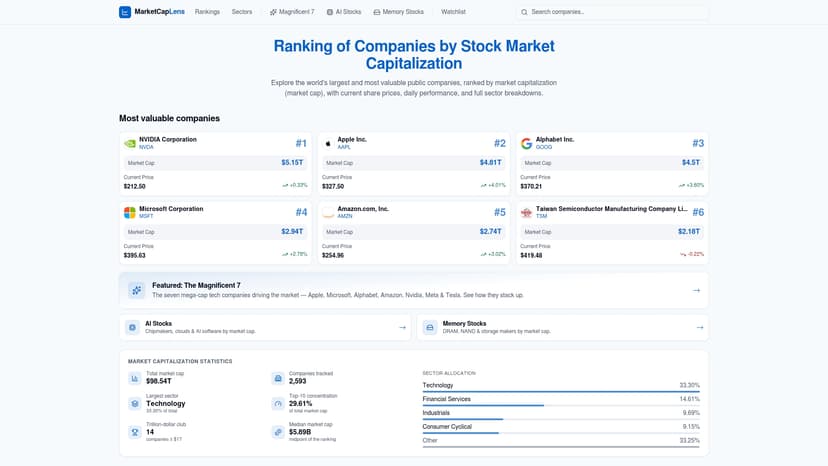
A halt is a data event as well as a trading event. The price freezes and the market cap you see for the stock freezes with it, until the reopening print moves it. That is why you want market cap rankings, sector views and daily moves in one place when a halt hits a large name. MarketCapLens tracks more than 2,500 public companies, with data refreshed multiple times daily. You can see where a company sits by size, which sector it belongs to and how its peers moved on the same day. After a reopening, the market cap calculator turns the new price times the share count into the new market cap. For a read on the whole market, daily market performance data helps you tell a single-stock event from a broad sell-off.
Our perspective
Halts are the market’s way of buying time for information to catch up with prices. The rules are mechanical, with a band, a timer and an auction, and that makes them readable once you know the codes.
What we care about is context. A stock stopped by a volatility pause means something different from one halted for pending news, and neither tells you much until you compare it with its sector and the market that day. A frozen price on its own is a single data point.
That is why we rank thousands of companies by market capitalization and show sector breakdowns and daily performance side by side. When a halt hits a large company, you can see how much of its sector and of the broader ranking depends on that one price, and what the move did to the picture once trading resumed.
MarketCapLens
FAQ
What is a trading halt?
A trading halt is a temporary suspension of trading in a specific security. It is typically called during the trading day so a company can announce important news or so the market can work through a large order imbalance. FINRA notes that all U.S. markets must honor it.
Why do stocks get halted?
The main reasons are pending or released news, extraordinary market activity, price moves beyond the limit up/limit down bands, listing non-compliance, regulatory concerns and SEC trading suspensions. Each has its own code on Nasdaq’s halt code list, so the code tells you which one applies.
How long do trading halts last?
It depends on the type. A volatility pause is five minutes before the reopening process starts, and a Level 1 or 2 market-wide halt is 15 minutes. News halts have no fixed length, and an SEC suspension can run up to 10 business days. Level 3 ends trading for the day.
What are the trading halt rules for the whole market?
Market-wide circuit breakers trigger when the S&P 500 drops 7%, 13% or 20% from the prior close. FINRA’s guide says the first two halt trading for 15 minutes if they happen before 3:25 p.m. The third halts trading for the rest of the day.
Is a halted stock a bad sign?
Not by itself. A halt shows that trading was stopped, and the reason code says why. A news-pending halt on a large company often precedes an ordinary announcement. Compliance codes such as H4, H9 or H10 point to regulatory issues, so read the code before drawing conclusions.
Sources
- Trading Halts, Delays and Suspensions, FINRA
- Trading Halts Code, Nasdaq Trader
- Investor Bulletin: Trading Suspensions, SEC
- FINRA Rule 6120, Trading Halts
- Guardrails for Market Volatility, FINRA
- Market-Wide Circuit Breakers FAQ, Nasdaq
- Plan to Address Extraordinary Market Volatility, NYSE
- Rule 80B interpretation, NYSE
- Limit Up/Down FAQ, Cboe
- Trading Halt History, Nasdaq Trader
Recommended
For informational purposes only and is not investment advice. Do not rely on the facts, figures, ticker symbols, or other statements in this article — they may be incomplete, outdated, or incorrect, and we are not responsible for errors. See our disclaimer.