Treasury Stock: What It Is and How It Changes Share Counts
By MarketCapLens · Published · 10 min read
Treasury stock, also called treasury shares, is stock a company issued, later bought back from investors and still holds without cancelling. Those shares stay on the books as issued but stop counting as outstanding, which changes earnings per share, equity and the market capitalization you calculate from a share price. Once you can read that one line on a balance sheet, you can tell why a company’s share count shrank and what the shrinkage does to the numbers you track.
MarketcaplensTrack Market Cap With Better ContextExplore company market capitalizations alongside share prices, sector breakdowns, historical data, and market trends.VisitTL;DR
- Treasury stock is a company’s own stock that was issued, reacquired and not retired. Cornell’s Legal Information Institute describes it as issued but not outstanding while the company holds it.
- Buying treasury shares lowers shares outstanding but not shares issued, so per-share measures such as earnings per share (EPS) rise even if total earnings do not.
- On the balance sheet, treasury stock appears as a contra-equity item: a deduction that reduces total stockholders’ equity.
- Treasury shares carry no vote, no dividend and no liquidation rights while the company holds them.
- For market cap work, use shares outstanding, not shares issued, and check the buyback trail in the filings.
Table of Contents
- What treasury stock means
- Authorized, issued, outstanding, treasury: the four counts
- How treasury stock appears on the balance sheet
- What happens when treasury shares are sold again
- Why companies buy back shares
- What treasury stock means for market cap
- See the numbers on MarketCapLens
- Our perspective
- FAQ
- Sources
What treasury stock means
A corporation sells shares to investors. Those are issued shares. If the company later buys some of them back on the market or from a holder, it has two choices: retire them or keep them in its own vault, so to speak. Shares kept and not retired are treasury stock.
The Cornell definition puts it simply: while the issuer holds them, the shares are considered issued but not outstanding, and they are not counted when measuring the value of outstanding common shares. A company cannot be its own shareholder in any meaningful sense, so these shares have no voting power, receive no dividends and have no claim on assets in a liquidation, as OpenStax’s financial accounting text explains.
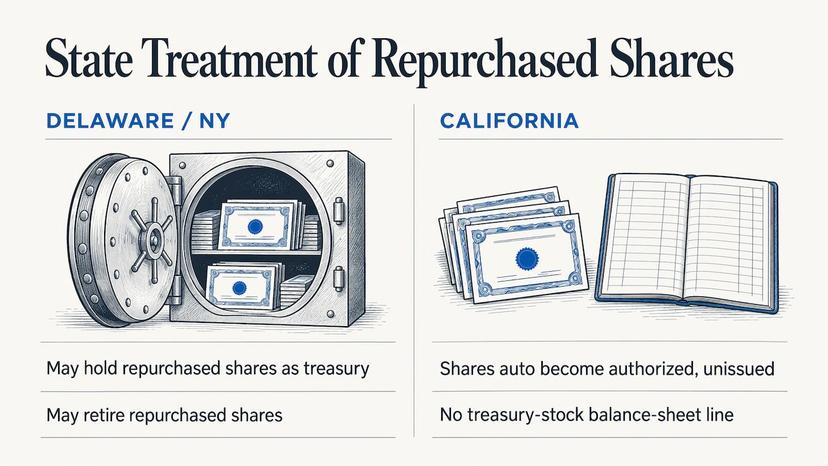
The choice between holding and retiring depends partly on state law. A 2012 U.S. treasury shares guide from the IBA notes that under Delaware and New York law a company may hold repurchased shares as treasury shares or retire them, while in California repurchased shares automatically become authorized but unissued. So a California company has no treasury stock line in the same sense, and the same buyback can look different on two balance sheets.
How a company ends up holding its own shares
The same guide lists the usual routes: a fixed-price tender offer, a modified Dutch auction, an open-market repurchase program, a privately negotiated purchase and an accelerated share repurchase. Open-market programs are the ones most investors see in headlines, because the board authorizes a dollar amount and management buys over months or years.
Open-market buying is also regulated. The SEC’s Rule 10b-18 is a safe harbor for buybacks, and as the CPA Journal summarized it, a company generally should not make the opening trade of the day or trade in the last 30 minutes before the close. The safe harbor is not absolute protection from litigation.
Authorized, issued, outstanding, treasury: the four counts
The confusion around this topic is almost always about which share count is meant. Here is the ladder.
| Term | Meaning | Changed by a treasury purchase? |
|---|---|---|
| Authorized | The maximum the charter lets the company issue | No |
| Issued | Shares ever sold to investors and not retired | No |
| Treasury | Issued shares the company bought back and holds | Increases |
| Outstanding | Issued minus treasury: the shares held by outsiders | Decreases |
| Retired | Repurchased shares cancelled, returning to authorized but unissued | Not applicable |
The SPSCC financial accounting text confirms that treasury stock transactions leave authorized and issued shares alone but change shares outstanding, while retiring stock reduces the number of shares issued.
A worked example
The NACM instructor manual gives the equation: issued stock minus reacquired (treasury) stock equals outstanding stock. Take its company: 1,000,000 shares authorized, 750,000 issued, 50,000 reacquired. Outstanding shares are 750,000 minus 50,000, or 700,000. The authorized and issued figures did not move.
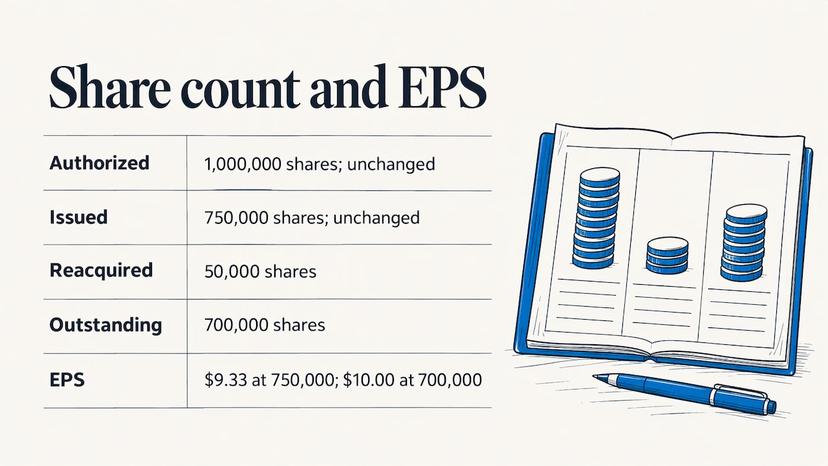
Now add a simple hypothetical on top. Say that company earns $7,000,000 in net income. On 750,000 shares, EPS would be $9.33. On 700,000 shares outstanding it is $10.00. Earnings did not grow by a dollar, yet EPS rose about 7%. That is the mechanical effect, and it is why analysts read buyback disclosures closely.
How treasury stock appears on the balance sheet
Treasury stock is not an asset, even though it feels like one. Under U.S. GAAP (generally accepted accounting principles), PwC’s guide to ASC 505-30 says treasury stock is recognized at the amount paid to repurchase the shares and recorded as a contra-equity reduction of stockholders’ equity. A contra account carries a debit balance and sits in the equity section as a subtraction, usually near the bottom, so total equity falls by what the company paid.
That is why a company with heavy buybacks can show small or even negative stockholders’ equity while remaining profitable. The cash left the company, and the equity line records it.
Cost method and par value method
Companies record the purchase in one of two ways. A peer-reviewed article on buybacks explains the difference:
- Cost method: the treasury stock account is debited for what was paid and shown as a deduction at the bottom of the equity section. This is the common approach.
- Par value method: no treasury stock account is used. The cost is deducted from paid-in capital accounts and the shares are treated as retired.
Under both, total stockholders’ equity falls by the amount of the buyback. The Texas Society of CPAs describes the same two methods in its January-February 2026 coverage.
Two details help when you read a footnote. Direct costs of acquiring the shares are generally added to the treasury stock cost, and the repurchase date matters for timing: PwC’s share repurchase guidance says most arrangements are recorded on the settlement date, with certain ASC 480 and ASC 815 arrangements recorded on the trade date.
Retiring instead of holding
A recent rule change touches the retirement path. The FASB issued ASU 2025-12 in December 2025, and the American Bar Association’s accounting review says it clarifies that the excess of repurchase price over par or stated value on retired shares may be deducted from additional paid-in capital (APIC) as long as APIC does not go negative. It takes effect for annual periods beginning after December 15, 2026. PwC’s retirement guide lists the permitted approaches and adds that the elected method must be applied consistently. If you compare two companies’ equity sections, check whether each holds or retires its repurchases.
What happens when treasury shares are sold again
Treasury shares can be reissued, for example to fund employee stock plans or an acquisition. The key point for anyone reading an income statement: reissuing treasury stock never creates a profit or loss. PwC’s guidance states that any gain or loss on reissuance is recognized in shareholders’ equity, not net income. A gain is credited to APIC. A loss is debited to APIC up to the earlier net gains on the same class of stock, and any remainder goes to retained earnings.
So if a company bought back shares at $40 and later sells them at $55, the $15 per share difference goes to APIC. Net income and EPS do not show it, although the extra shares outstanding after reissuance will dilute per-share figures. For the dilution side of that, see our piece on share dilution effects on your stake and returns.
Why companies buy back shares
The IBA guide lists several motives: returning capital to shareholders, raising EPS, buying shares management thinks are underpriced, offsetting dilution from stock options and providing liquidity. OpenStax adds that buybacks can help block a hostile takeover, create demand that supports the market price and supply shares for employee plans.
The EPS effect deserves care. The same peer-reviewed article notes that because EPS divides earnings by shares outstanding, a buyback shrinks the denominator and lifts EPS without any rise in total earnings. It also cautions that some companies time buyback announcements just before earnings reports so that results beat analyst forecasts. A comment letter filed with the SEC’s share repurchase disclosure rulemaking gives a scale example: in fiscal 2021 Apple bought 656 million shares for $86 billion, about 3.9% of the prior year’s average shares outstanding, and the letter attributes a $0.20 EPS lift to that.
Because treasury shares are excluded from the weighted average shares outstanding for basic and diluted EPS, the effect shows up in reported EPS immediately. If you want to turn that into a valuation, work through what a different EPS does to price. A tool such as an after-tax compound growth calculator shows how per-share gains compound over years once taxes are taken into account, which helps you judge how much a buyback-driven EPS rise is worth to a long-term holder.
What treasury stock means for market cap
Market capitalization is share price multiplied by shares outstanding. Since treasury shares are not outstanding, they drop out of that multiplication. When a company retires or holds a large block of its own stock, its market cap at a given price falls compared with a count based on issued shares.
That creates three habits worth building:
- Use the cover page of the latest 10-K or 10-Q for shares outstanding, and compare it with the issued figure in the equity section. The gap is the treasury stock.
- Track the buyback trend across quarters. A shrinking share count over several years tells you more than a single announcement.
- Adjust for dilution. Options and convertibles can offset a buyback, so a falling count is not automatically a falling fully diluted count. Our walkthrough on verifying fully diluted market cap covers the check, and three quick checks analysts use on buybacks and market cap puts the routine in order.
If you are comparing companies, remember that a stock split changes counts too, but in a different way: the company’s total value is unchanged while shares multiply. See what a stock split does to shares and cost basis so you do not confuse the two.
See the numbers on MarketCapLens
MarketCapLens tracks more than 2,500 public companies, ranks them by market capitalization and refreshes its data multiple times a day, with sector breakdowns alongside. When a company’s buyback moves its share count, the effect lands in the market cap and ranking you see, so you can follow the story from the filing to the leaderboard. Start with the market cap rankings and then compare firms inside a sector on the sector pages.
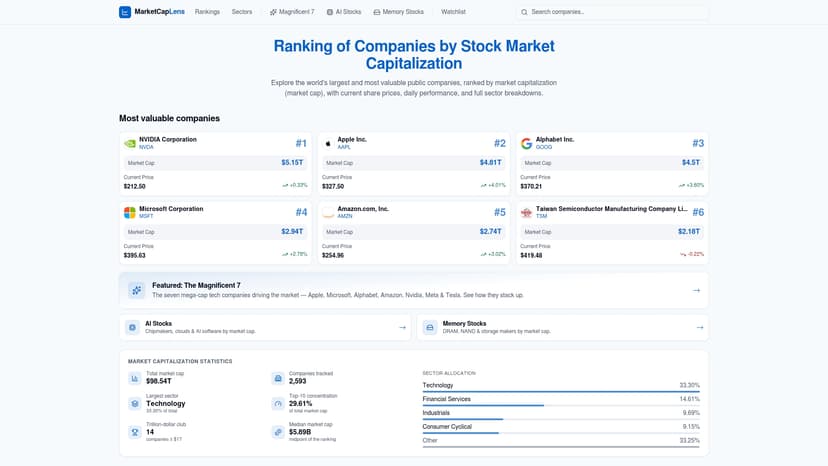
When you want to test a number, the stock calculators let you work with share counts, prices and returns directly.
Our perspective
Treasury stock is one of the clearest examples of why a market cap figure is only as good as the share count behind it. Two companies can post the same price and the same earnings, yet one has retired a fifth of its shares and the other has issued more through option grants. The per-share story, and the size ranking, differ.
That is the reason we built MarketCapLens around a wide, frequently refreshed view of more than 2,500 companies, with sector breakdowns, historical performance and plain-English explanations next to the data. A buyback should be something you can trace: the price, the shares outstanding, the market cap and where the company sits among its peers.
Our advice to investors, analysts and finance students is to read treasury stock as a pointer, not a verdict. It tells you where to look in the filings, and then the rankings and sector context tell you whether the move changed the company’s standing.
MarketCapLens
FAQ
Is treasury stock an asset or equity?
It is equity, specifically a contra-equity account. Under the cost method it carries a debit balance and is subtracted from stockholders’ equity, so it lowers total equity by what the company paid for the shares, as PwC’s ASC 505-30 guidance describes.
What is the difference between treasury shares and outstanding shares?
Treasury shares are issued shares the company holds itself. Outstanding shares are issued shares minus treasury shares, meaning the ones held by outside investors. Only outstanding shares vote, receive dividends and count in EPS and market cap.
Do treasury shares pay dividends or vote?
No. Because they are not outstanding, treasury shares have no dividend, voting or liquidation rights while the company holds them. If the company reissues them, the new holders gain those rights.
What is the difference between treasury stock and retired stock?
Treasury stock stays issued and can be reissued. Retired stock is cancelled, which reduces the number of issued shares and, in the SPSCC text’s words, makes the balance sheet look as if the stock was never issued. Some states, such as California, treat repurchased shares as automatically retired.
Does selling treasury stock create income?
No. Gains or losses on reissuing treasury shares go to shareholders’ equity, mainly APIC and retained earnings, rather than to net income.
Sources
- Treasury stock, Cornell Law School Legal Information Institute
- United States treasury shares guide, IBA Corporate and M&A Law Committee (2012)
- Analyze and record transactions for the issuance and repurchase of stock, SPSCC Financial Accounting
- Corporations: Organization, NACM instructor manual
- Treasury stock, PwC Viewpoint
- Share repurchases, PwC Viewpoint
- Share retirement after adoption of ASU 2025-12, PwC Viewpoint
- Analyze and record transactions for the issuance and repurchase of stock, OpenStax
- Stock buybacks: good or bad, Journal of Business and Economics Research
- Share repurchases, Today’s CPA, Texas Society of CPAs
- Accounting Developments 2025, American Bar Association
- Comment letter, SEC File No. S7-21-21
- Rule 10b-18 summary, The CPA Journal
Recommended
For informational purposes only and is not investment advice. Do not rely on the facts, figures, ticker symbols, or other statements in this article — they may be incomplete, outdated, or incorrect, and we are not responsible for errors. See our disclaimer.